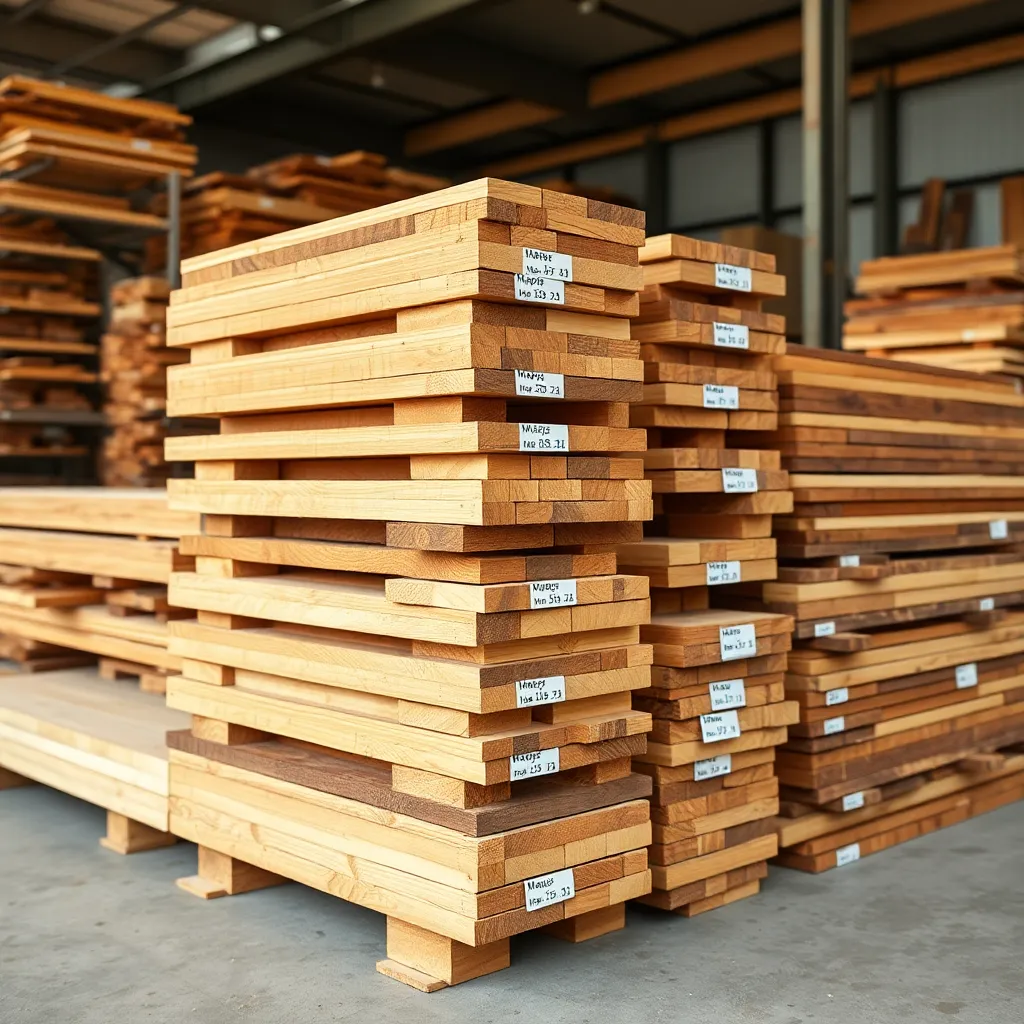
Board feet is the standard unit for pricing and selling hardwood lumber. One board foot = 144 cubic inches of wood (1″ thick × 12″ wide × 12″ long). Understanding how to calculate board feet lets you buy the right amount of lumber, compare prices between boards of different sizes, and price your projects accurately.
Ted’s Woodworking has complete cut lists for every project — every board foot calculation done for you. Browse Ted’s plans →
Step 1: Learn the Board Foot Formula

Goal: Memorize the single formula that calculates board feet for any board.
Board Feet = (Thickness × Width × Length) ÷ 144
Where thickness and width are in inches, and length is in inches.
Alternatively, if length is already in feet:
Board Feet = (Thickness × Width × Length in feet) ÷ 12
Example: a board that is 1 inch thick, 6 inches wide, and 8 feet long:
- Formula: (1 × 6 × 8) ÷ 12 = 48 ÷ 12 = 4 board feet
This works for any dimensions — just keep thickness and width in inches, and length in either feet or inches (using the appropriate divisor).
Milestone: Calculate the board feet of a 2-inch thick, 8-inch wide, 10-foot board without a calculator. (Answer: 2 × 8 × 10 ÷ 12 = 13.33 board feet)
Step 2: Calculate Board Feet for Boards Thinner Than 1 Inch

Goal: Handle the common case of thin stock (¾-inch, ½-inch, ¼-inch boards).
For boards thinner than 1 inch, use the actual thickness as a decimal in the formula.
- ¾ inch = 0.75
- ½ inch = 0.5
- ¼ inch = 0.25
Example: a ¾-inch thick, 6-inch wide, 4-foot board:
- (0.75 × 6 × 4) ÷ 12 = 18 ÷ 12 = 1.5 board feet
Important note on hardwood pricing: many lumber dealers price boards under 1 inch thick as if they were 1 inch thick (called “4/4” thickness). This is industry standard — a ¾-inch thick board that has been surfaced from 1-inch rough stock is priced at the 1-inch (4/4) rate. Always confirm the dealer’s thickness pricing policy.
Milestone: Calculate board feet for a ½-inch × 8-inch × 6-foot panel. (Answer: 0.5 × 8 × 6 ÷ 12 = 2 board feet)
Step 3: Calculate Board Feet for a Complete Cut List

Goal: Total the board feet for every part in a project cut list.
To calculate lumber needed for a project:
- 1. List every part with dimensions (thickness × width × length)
- 2. Calculate board feet for each part
- 3. Sum all board feet
- 4. Add 20% for waste (defects, saw kerfs, miscuts)
Example cut list for a small side table:
- 4 legs: 1.5″ × 1.5″ × 28″ each → (1.5 × 1.5 × 28) ÷ 144 = 0.44 BF each × 4 = 1.75 BF
- 1 top: 1″ × 18″ × 24″ → (1 × 18 × 24) ÷ 144 = 3 BF
- 2 aprons: 1″ × 3″ × 16″ each → (1 × 3 × 16) ÷ 144 = 0.33 BF each × 2 = 0.67 BF
- Total: 5.42 BF + 20% waste = 6.5 BF
Milestone: Build a complete cut list for one project and calculate total board feet with 20% waste added.
Step 4: Understand Hardwood Thickness Notation (Quarter System)

Goal: Read thickness designations at the lumber yard (4/4, 5/4, 6/4, 8/4).
Hardwood lumber thickness is sold in quarters of an inch:
- 4/4 (four-quarter) = 1 inch rough (surfaces to approximately ¾ inch finished)
- 5/4 (five-quarter) = 1¼ inches rough (surfaces to approximately 1 inch finished)
- 6/4 (six-quarter) = 1½ inches rough (surfaces to approximately 1¼ inches finished)
- 8/4 (eight-quarter) = 2 inches rough (surfaces to approximately 1¾ inches finished)
- 12/4 (twelve-quarter) = 3 inches rough (surfaces to approximately 2½ inches finished)
When calculating board feet at the lumber yard: use the nominal (rough) thickness, not the surfaced thickness. A 4/4 board is priced at 1-inch thickness even if it has been surfaced to ¾ inch.
Milestone: At a lumber yard, identify boards by their quarter thickness and convert to actual rough dimensions.
Step 5: Compare Price Per Board Foot
Goal: Use price-per-board-foot to compare value between boards of different sizes.
To find the price per board foot of any board:
Price per BF = Total price ÷ Board feet in the board
Example: a walnut board priced at $45, measuring 1″ × 7″ × 8′:
- Board feet: (1 × 7 × 8) ÷ 12 = 4.67 BF
- Price per BF: $45 ÷ 4.67 = $9.64 per board foot
Compare two boards of the same species from the same dealer — the one with lower price per board foot is the better value regardless of physical size. Also note: wider boards typically cost more per board foot than narrower boards (because wide clear stock is rarer).
Milestone: Calculate price per board foot for three different boards and rank them by value.
Step 6: Build a Board Foot Reference Table

Goal: Create a quick-reference table for the most common board dimensions.
| Thickness | Width | 1-foot length | 4-foot length | 8-foot length |
|---|---|---|---|---|
| 1″ (4/4) | 4″ | 0.33 BF | 1.33 BF | 2.67 BF |
| 1″ (4/4) | 6″ | 0.5 BF | 2 BF | 4 BF |
| 1″ (4/4) | 8″ | 0.67 BF | 2.67 BF | 5.33 BF |
| 1″ (4/4) | 10″ | 0.83 BF | 3.33 BF | 6.67 BF |
| 1″ (4/4) | 12″ | 1 BF | 4 BF | 8 BF |
| 1.25″ (5/4) | 6″ | 0.63 BF | 2.5 BF | 5 BF |
| 1.5″ (6/4) | 6″ | 0.75 BF | 3 BF | 6 BF |
| 2″ (8/4) | 6″ | 1 BF | 4 BF | 8 BF |
| 2″ (8/4) | 8″ | 1.33 BF | 5.33 BF | 10.67 BF |
Milestone: Use this table to estimate lumber cost for a small project before calculating precisely.
Board Feet Calculator FAQ
What is the difference between board feet and square feet?
Square feet measures area (length × width). Board feet measures volume (length × width × thickness). A 1-inch thick board has a 1:1 relationship between square feet and board feet — one square foot of 1-inch thick material is one board foot. A ½-inch thick board has 0.5 board feet per square foot. An 8-foot long, 6-inch wide board has 4 square feet of surface area; at 1-inch thick, it’s 4 board feet; at ¾-inch thick, it’s approximately 3 board feet (though it may still be priced as 4 BF at the lumber yard). Always clarify whether a price is per square foot (common for sheet goods like plywood) or per board foot (common for hardwood lumber).
How many board feet are in a standard 2×4×8?
A 2×4 is nominally 2 inches by 4 inches — but for board foot calculation, use the nominal dimensions (not the actual 1.5 × 3.5 inch dimensions). The board foot calculation for a 2×4×8: (2 × 4 × 8) ÷ 12 = 5.33 board feet. In practice, dimensional lumber (2×4s, 2×6s, etc.) is sold by the linear foot at home centers, not by the board foot. The board foot calculation only becomes relevant when purchasing dimensional lumber in bulk from a mill or comparing it to hardwood prices.
How much waste should I add to my board foot calculation?
Add 20% for most projects — this covers saw kerfs (each cut removes ⅛ inch of material), small defects (knots, checks, sapwood you choose to cut around), and the occasional miscut. Add 25–30% for projects with many small pieces (more cuts, more opportunities for waste), projects using figured or heavily figured wood (more defects to route around), or first-time builders who expect more miscuts. Add 10–15% for simple projects with long boards and few cuts, or when using pre-dimensioned material. For sheet goods (plywood, MDF): add only 10% waste because sheet goods are dimensionally consistent and efficient to cut.
Do I calculate board feet using nominal or actual lumber dimensions?
At the lumber yard: use nominal dimensions for pricing. When planning joinery and fit: use actual dimensions for everything. The disconnect causes the most confusion at the planning stage — a project plan that calls for a 1×6 board for a shelf means a board that’s actually ¾ inch thick and 5½ inches wide. If you design the shelf depth as 6 inches using the nominal width, the shelf will be ½ inch shallower than expected. Always design with actual dimensions; only use nominal dimensions when calculating board feet for pricing purposes.

“DIY woodworking enthusiast who started with zero experience and a YouTube tutorial.
I build simple, practical projects for my home and share free plans
so other beginners can skip the guesswork.If I can build it, you can too.”