Plywood grading is a straightforward system once you understand the letter code — but buying the wrong grade for cabinets is one of the most common material mistakes woodworkers make. The A-D grading system rates each face separately, and the right grade combination depends on which faces will be visible in the finished cabinet. This guide covers the full grading system, what each grade looks like in person, and which grades to specify for different cabinet applications.
Ted’s Woodworking has complete cabinet plans with material specifications and cut lists. Browse Ted’s plans →
Step 1: Understand the A-D Grading System
Goal: Read and interpret the two-letter grade designation on any plywood sheet.
North American plywood grading uses letters A through D to describe the quality of each veneer face. The designation appears as two letters separated by a hyphen — the first letter is the front face, the second is the back face.
Grade A: The highest quality face. Sanded smooth to a consistent surface. Repairs (football-shaped wood patches, filled knots, small splits) are allowed but must be neatly done and lie flat. Suitable for paint or clear finish without additional prep beyond final sanding.
Grade B: Good face. More repairs are allowed than A. Some minor splits are permitted if they don’t affect appearance significantly. Small open defects allowed. Suitable for paint after light filling.
Grade C: Knots up to 1.5 inches, open knotholes up to 1 inch, splits, minor sanding defects allowed. Not suitable for natural finishes. Used as the hidden face in structural panels or as a substrate for paint in utilitarian applications.
Grade D: The lowest grade. Knotholes up to 2.5 inches in diameter, significant splits, and multiple defects allowed. Used only as the completely hidden face in structural applications — never for visible surfaces.
Milestone: At a lumber yard, pick up two sheets with different grade designations and verify you can identify the face and back quality by visual inspection alone.
Step 2: Identify Hardwood vs Softwood Plywood Grades
Goal: Distinguish the two parallel grading systems and know which applies to cabinet work.
The A-D system described above applies to softwood plywood (Douglas fir, southern pine, and similar species). A separate grading system applies to hardwood veneer plywood (birch, oak, maple, cherry, walnut, and other furniture-grade species).
Hardwood plywood grades (HPVA standard):
Hardwood plywood uses a combined designation: face grade / back grade (e.g., 1/2 or 2/3). Some suppliers use “A-1” or “A-2” informally to describe hardwood veneer plywood with an A-quality face and Grade 1 or 2 back.
Baltic birch uses its own designation (B/BB, BB/CP, B/WG) that doesn’t map directly to either system — see Step 3 for Baltic birch specifics.
Milestone: At a lumber yard, identify whether a sheet is softwood or hardwood veneer plywood, and read the grade designation from the stamp or edge marking.
Step 3: Learn Baltic Birch Grades
Goal: Understand Baltic birch’s separate grading system and its cabinet applications.
Baltic birch plywood (imported from Finland, Russia, or Baltic states) uses a letter/letter system where each letter describes one face:
B/BB: B-face (smooth, minimal repairs) / BB-face (small filled knots, patches allowed). The best grade for visible furniture faces.
BB/CP: BB-face / CP-face (more repairs and patches on back). Standard cabinet-grade Baltic birch — excellent for cabinet boxes where only the front face shows.
B/WG (or B/C): B-face / WG or C back (significant knots and patches). Used where the back is completely hidden.
Why Baltic birch for cabinets: Baltic birch has more plies (9–13 plies in a ¾” sheet vs 5–7 in standard birch), virtually no voids in the core, and consistent thickness. The edge, when exposed, shows the laminated plies — an attractive detail in modern/Scandinavian-style furniture. Screws hold better in the void-free core than in standard domestic plywood.
Milestone: Compare a cross-section edge of Baltic birch to standard domestic birch plywood and count the plies in each.
Step 4: Match Grade to Cabinet Application
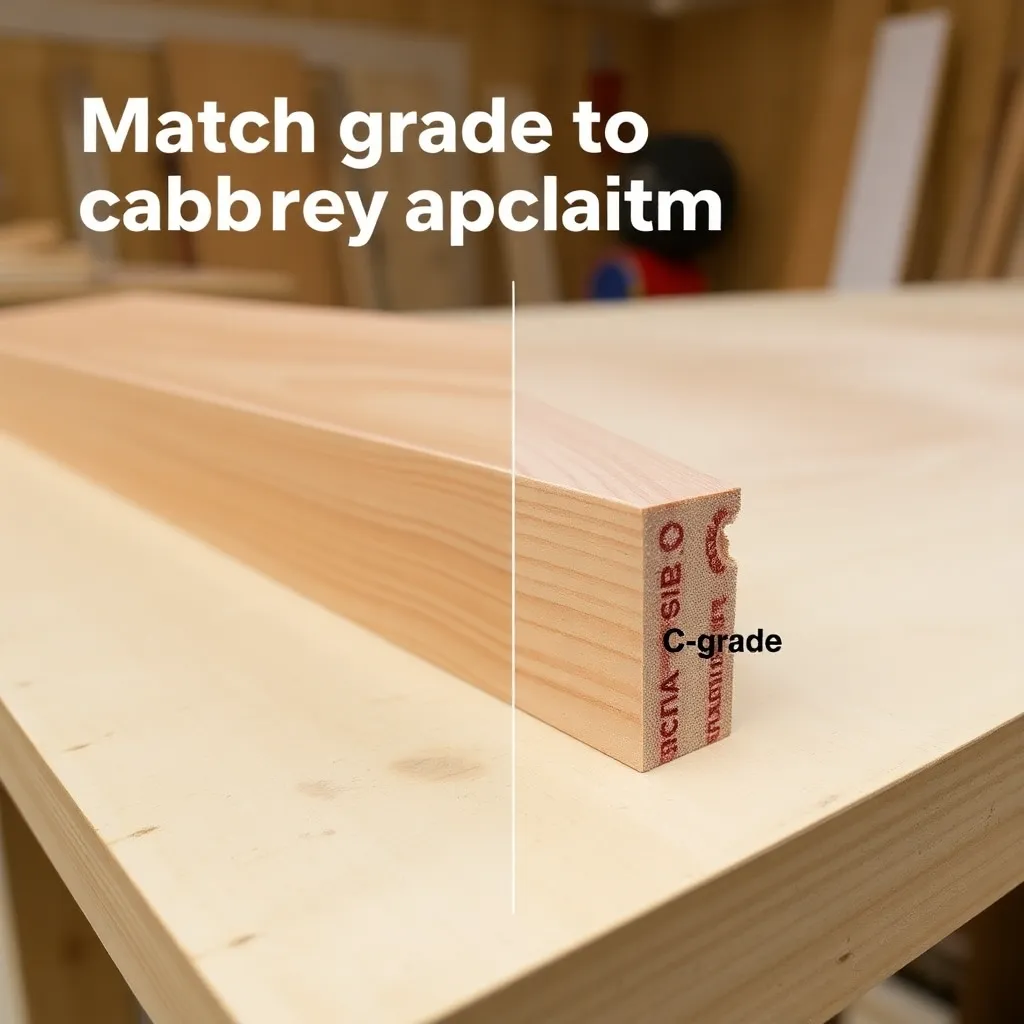
Goal: Select the correct grade combination for each part of a cabinet build.
| Cabinet Part | Visibility | Recommended Grade |
|---|---|---|
| Face-frame cabinet box (sides, top, bottom) | Hidden by face frame | B-C or BB/CP Baltic birch |
| Frameless (Euro-style) cabinet box | Interior visible | A-B or BB/BB Baltic birch |
| Cabinet door (natural finish) | Fully visible, both faces | A-1 hardwood veneer or B/BB Baltic birch |
| Cabinet door (painted) | Front visible | A-B or MDF-core |
| Drawer boxes | Interior partially visible | BB/CP Baltic birch or ½” B-C |
| Cabinet back panel | Mostly hidden | ¼” B-C or ¼” lauan |
| Adjustable shelves | Top face visible | A-B or BB/CP |
| Shop cabinet (utility) | Not critical | B-C or CDX |
Key principle: only pay for grade where it’s visible. Using A-1 hardwood veneer for hidden cabinet box sides wastes money with no visual benefit.
Milestone: For a specific cabinet you’re planning, write down the grade you’d specify for each component.
Step 5: Read the Grade Stamp
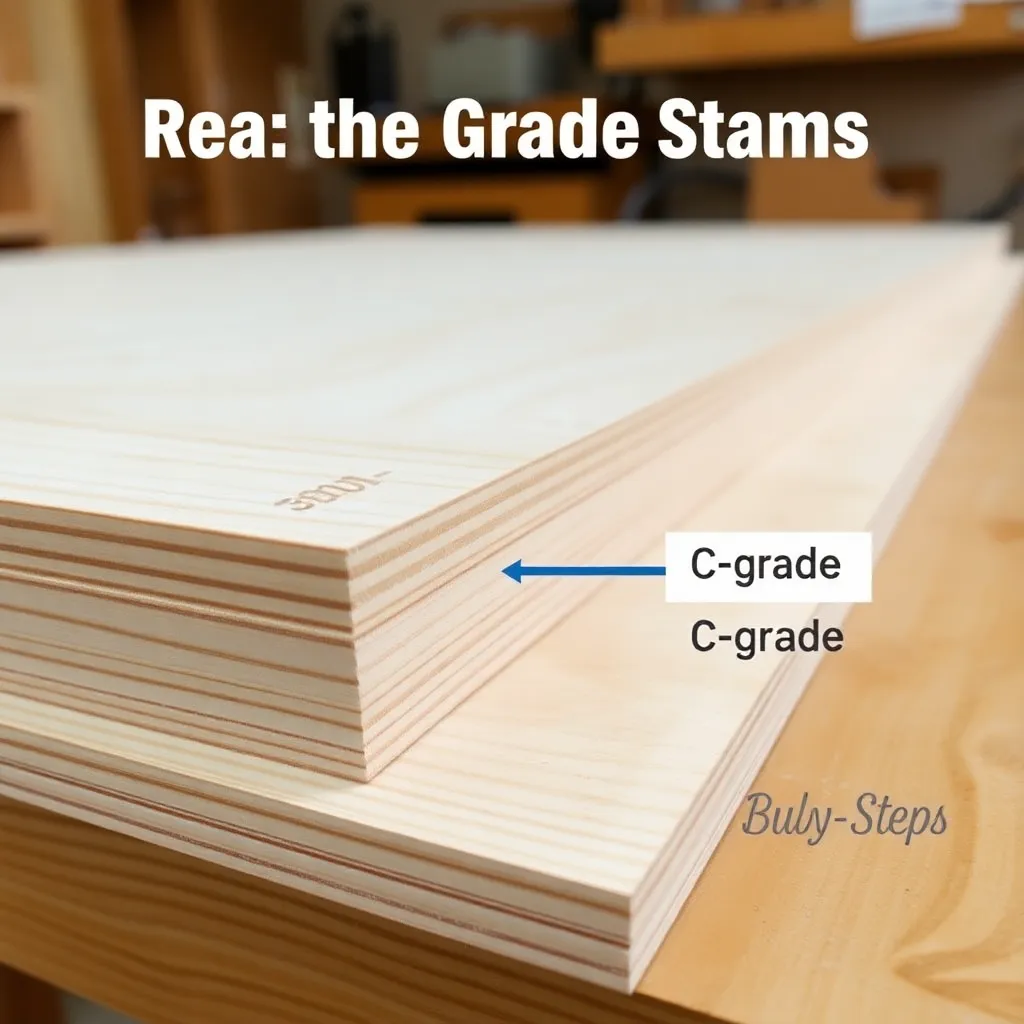
Goal: Extract all relevant information from the grade stamp on the panel edge or face.
North American softwood plywood carries a grade stamp from an approved testing agency (APA — The Engineered Wood Association is the most common). The stamp contains:
Grade: The A-D letter designation (e.g., “SHEATHING” or “RATED SHEATHING” for structural grades; “A-C” or “B-C” for appearance grades)
Exposure rating:
Span rating: applies to structural/sheathing grades — the number pair (e.g., “32/16”) indicates maximum spacing of rafters/joists the panel can span.
Mill number: identifies the manufacturing plant.
For cabinet applications: look for Exposure 1 minimum on any panel that might be exposed to kitchen or bathroom moisture. Interior-only rated plywood is appropriate for bedroom furniture and dry environments.
Milestone: Find the APA stamp on a sheet of plywood at a home center and identify the grade, exposure rating, and thickness designation.
Step 6: Avoid the Most Common Plywood Grading Mistakes
Goal: Recognize and avoid the purchasing errors that cost time and money.
Mistake 1: Buying CDX for cabinet boxes. CDX is a structural sheathing grade (C face, D back, Exterior glue) — it’s rough, unsanded, and full of defects on both faces. It’s intended for roof sheathing and subfloors, not cabinetry. Cost is lower, but the sanding and filling required to make it usable for cabinets costs more time than the price difference saves.
Mistake 2: Confusing nominal and actual thickness. ¾” cabinet plywood is actually 23/32″ (0.719″). If you cut a dado for a ¾” shelf at true ¾” (0.750″), the shelf will rattle in the dado. Measure the actual thickness before cutting joinery and size dados to fit.
Mistake 3: Ignoring core type. The grade system describes the veneers, not the core. MDF-core plywood is heavy and doesn’t hold screws at the edge (parallel to the face). Veneer-core holds screws better but may have voids. For drawer slides and hardware that require strong screw-holding at the edge: specify veneer-core or Baltic birch.
Mistake 4: Buying the minimum grade for the application. The cheapest sheet that technically works often requires significant prep — filling, sanding, priming — that eliminates the cost savings. For painted cabinets where appearance matters: the extra cost of A-grade over B-grade faces is often worth it.
Milestone: Before your next cabinet build, write a material specification that lists grade, core type, and exposure rating for each panel component.
Cabinet Plywood Grades FAQ
What does A-C plywood mean?
A-C plywood has an A-grade face (smooth, sanded, minimal neat repairs) and a C-grade back (knots up to 1.5″, open knotholes up to 1″, splits allowed). The “A” face is suitable for paint or natural finish; the “C” back is intended to be hidden. A-C is commonly used for soffits, shelving where only one face shows, and painted cabinet sides where the back faces a wall. It’s one step below A-B in quality and cost.
Is birch plywood good for cabinets?
Birch plywood is one of the best choices for cabinets. It has a tight, even grain that sands smooth, takes both paint and clear finishes well, and holds screws reliably. Baltic birch is particularly valued for its void-free core, consistent thickness, and clean layered edges. The downsides: birch plywood is more expensive than standard construction grades, and the plain grain of birch doesn’t have the visual interest of oak or maple if you’re doing a natural-finish cabinet with visible sides. For painted cabinets: birch is excellent. For natural-finish cabinets: choose the veneer species (oak, maple, cherry, walnut) rather than birch unless the minimal grain is part of the design intent.
What plywood grade should I use for kitchen cabinets?
For professional results in kitchen cabinets: ¾” A-1 or A-2 hardwood veneer plywood (birch veneer is standard) for the visible interior of frameless cabinets; ¾” B-C or BB/CP Baltic birch for face-frame cabinet boxes where the sides are hidden behind the face frame; ½” Baltic birch or B-C for drawer boxes; ¼” B-C or lauan for cabinet backs. The interior-visible surfaces of kitchen cabinets (inside a base cabinet with no door) should be at minimum A-grade or Grade 2 hardwood veneer — the inside of a kitchen cabinet is inspected daily when opening doors and drawers.
What is the difference between plywood grades for cabinets and structural grades?
Cabinet-grade plywood (appearance grades like A-B, A-C, and hardwood veneer grades) prioritizes surface quality — smooth, sanded faces, minimal visible defects, consistent thickness. Structural grades (CDX, OSB, Sheathing) prioritize structural performance — load-bearing capacity, consistent shear strength — without concern for surface appearance. Structural grades use Exterior glue (which is an advantage) but have rough, defect-filled faces that require extensive prep for any finished application. Never use structural-grade plywood for visible cabinet surfaces. The cost difference is real but small compared to the prep work required to use structural grades for appearance applications.

“DIY woodworking enthusiast who started with zero experience and a YouTube tutorial.
I build simple, practical projects for my home and share free plans
so other beginners can skip the guesswork.If I can build it, you can too.”