
Woodworking has shaped human civilization for millennia, yet most DIY enthusiasts today overlook the sophisticated techniques that ancient artisans mastered centuries ago. Contrary to common belief, woodworking in ancient times was not rudimentary labor but a highly skilled craft performed by trained guild members using advanced tools and joinery methods. This guide explores the evolution of woodworking tools, traditional techniques, and cultural impacts from ancient civilizations to modern North America, revealing how historical knowledge can transform your DIY projects and deepen your appreciation for the craft.
Table of Contents
- Evolution Of Woodworking Tools
- Ancient Woodworking Techniques And Labor
- Woodworking Traditions In North America
- Industrialization And The Craft Revival
- Common Misconceptions About Woodworking History
- Applying Historical Insights To Your Woodworking Projects
- Summary And Inspiration From Woodworking History
- Explore Woodworking Plans And Tools For Your Next Project
Key takeaways
| Point | Details |
|---|---|
| Tool evolution | Hand tools like planes, chisels, and saws retained core designs from the 17th through 20th centuries with only incremental changes. |
| Ancient craftsmanship | Roman woodworkers were organized in skilled guilds, using bronze measuring tools and iron cutting tools to create sophisticated work. |
| Traditional joinery | Mortise and tenon joints date back to ancient Egypt around 3000 BC and remain essential for strong, beautiful furniture today. |
| North American heritage | Appalachian craftsmen blended indigenous and settler techniques, emphasizing self-sufficiency with local woods before industrialization. |
| Craft revivals | Mass production reduced but never eliminated handcrafted woodworking, sparking 20th-century movements that preserved traditional skills. |
Evolution of woodworking tools
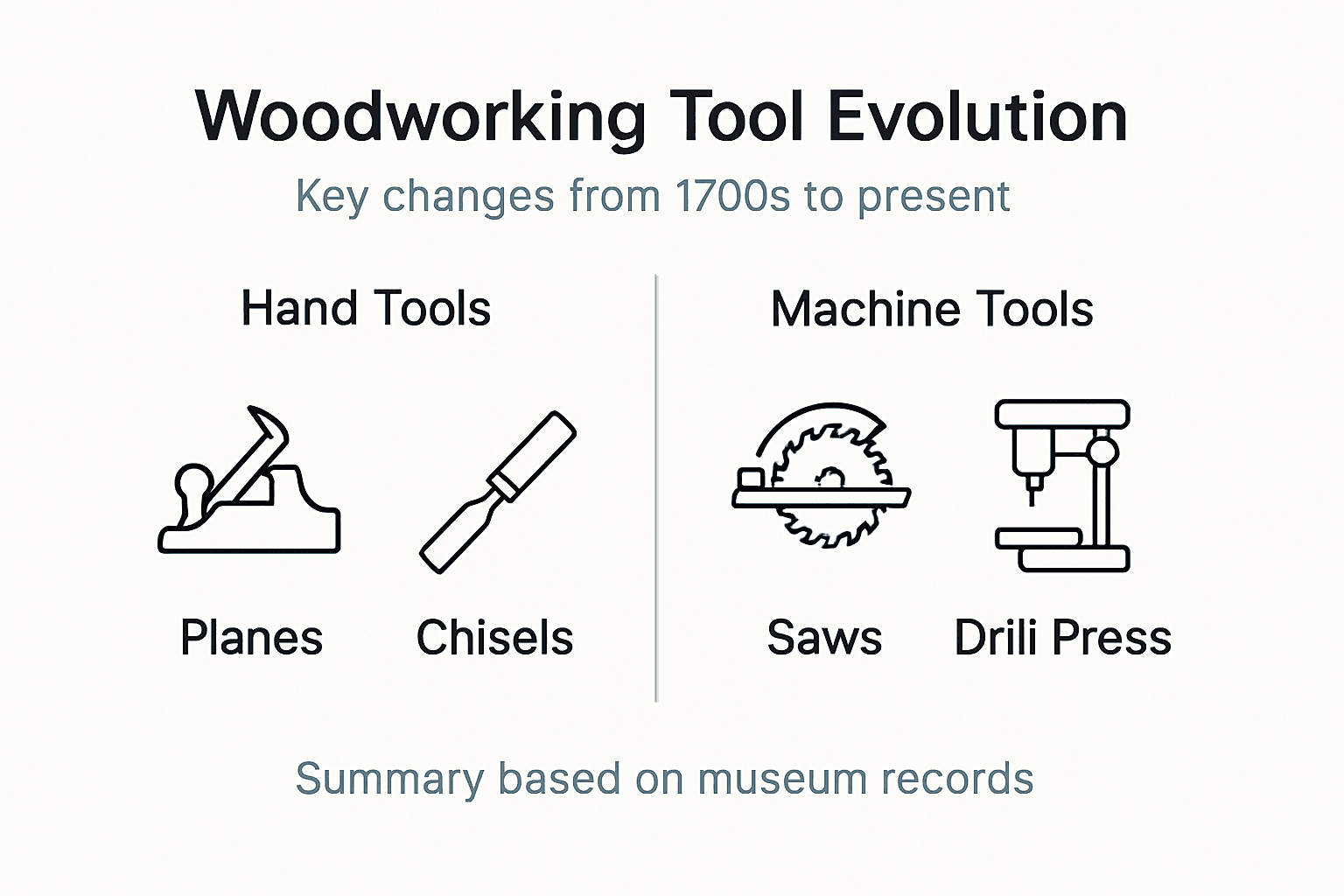
Basic woodworking hand tools evolved little between 17th and 20th centuries, demonstrating remarkable consistency in design efficiency. Planes, chisels, and saws maintained their fundamental forms across three centuries, with modifications focused on refinement rather than radical change. This stability reflects the timeless effectiveness of tool designs that emerged from centuries of craftsman experimentation.
Tool materials progressed strategically over time. Bronze served primarily for measuring and layout tools, while iron and later steel dominated cutting applications. This material division optimized each tool’s performance for its specific task. Regional design differences emerged as British and Continental influences shaped specialized tools adapted to local woodworking traditions and available materials.
Understanding this evolution helps modern woodworkers make informed tool choices. When selecting hand tool woodworking essentials, recognize that many current designs trace directly back centuries. The longevity of these forms validates their effectiveness and teaches us that innovation often means refinement, not replacement.
Key tool developments by era:
- 17th century: Establishment of core hand tool forms including bench planes and mortise chisels
- 18th century: Regional specialization with British pattern saws and Continental molding planes
- 19th century: Steel manufacturing improvements enhanced edge retention and tool durability
- Early 20th century: Standardization of tool sizes and ergonomic handle refinements
| Tool Type | Primary Material | Main Function | Evolution Pattern |
|---|---|---|---|
| Measuring tools | Bronze, later brass | Layout and precision | Minimal form change |
| Cutting tools | Iron, later steel | Shaping and joinery | Incremental refinement |
| Planes | Wood body with metal blade | Surface smoothing | Regional variations |
| Saws | Steel with wooden handle | Cutting operations | Tooth pattern specialization |
Pro Tip: When building your tool collection, prioritize quality over quantity by investing in well-made planes and chisels that mirror historical designs, as these proven forms deliver superior results compared to modern shortcuts.
Exploring museum collections of woodworking tools reveals fascinating details about regional variations and maker innovations. These resources provide blueprints for understanding tool capabilities that remain relevant today.
Ancient woodworking techniques and labor
Ancient Roman carpenters were organized in guilds with specialized training, not unskilled laborers performing basic tasks. These craftsmen, often slaves or lower-class workers, developed sophisticated techniques that rivaled modern standards. Guild structures ensured knowledge transfer across generations, maintaining high skill levels throughout the empire.
Tool material choices in ancient times reflected practical metallurgy. Bronze tools handled measuring and layout tasks where precision mattered more than cutting force. Iron tools dominated cutting operations, offering the hardness needed for shaping wood effectively. This strategic material use maximized each metal’s properties.
Joinery techniques like mortise and tenon originated in ancient Egypt around 3000 BC, proving these methods have stood the test of millennia. Dovetail joints appeared later but also demonstrate ancient origins. These connections provided strength without metal fasteners, creating furniture that survived centuries. Modern DIY woodworkers benefit immensely from mastering these proven joinery techniques.
Core ancient joinery methods still used today:
- Mortise and tenon: Rectangular peg fits into matching hole for strong frame connections
- Dovetail joints: Interlocking wedge-shaped pins create drawer and box corners that resist pulling apart
- Lap joints: Overlapping wood pieces provide simple but effective connections for frames
- Dowel joinery: Cylindrical pegs reinforce connections and align components accurately
Pro Tip: Practice mortise and tenon joints on scrap wood before tackling your project, as ancient craftsmen spent years perfecting these fundamental skills that distinguish quality furniture from basic construction.
These traditional techniques offer advantages beyond strength. They create visual interest through exposed joinery that showcases craftsmanship. Hand-cut joints develop skills that improve overall woodworking ability. Understanding ancient Roman woodworking practices reveals how guild training systematically built expertise from apprentice to master level.
The aesthetic appeal of traditional joinery methods adds character that modern fasteners cannot match. Exposed dovetails on drawer fronts signal quality construction. Through tenons visible on table aprons demonstrate structural integrity. These details connect contemporary projects to woodworking heritage spanning thousands of years.
Woodworking traditions in North America
North American woodworking developed distinct characteristics shaped by indigenous techniques and settler resourcefulness. Native peoples crafted sophisticated wooden tools, containers, and structures long before European contact. Early settlers adapted these methods while bringing their own traditions, creating a hybrid approach suited to frontier conditions.
Appalachian handmade crafts emphasized self-sufficiency using locally available woods before industrialization transformed production. Craftsmen produced household furniture, farm tools, and everyday items from nearby forests. This practical focus created durable designs without ornamental excess. Functionality drove form in ways that still resonate with modern minimalist aesthetics.
Cultural heritage profoundly influenced regional woodworking styles. German settlers brought precision joinery traditions. Scandinavian immigrants contributed clean-lined furniture designs. English colonists introduced formal furniture forms adapted to new woods like cherry and walnut. These blended traditions created uniquely American woodworking expressions.
Characteristic features of North American woodworking traditions:
- Emphasis on locally sourced hardwoods including oak, maple, cherry, and walnut
- Practical designs prioritizing durability and utility over decorative elements
- Self-sufficient production methods using hand tools and water-powered sawmills
- Intergenerational skill transmission through apprenticeship and family teaching
- Adaptation of European joinery methods to available tools and materials
Understanding these regional traditions helps contemporary woodworkers appreciate design choices beyond mere aesthetics. Shaker furniture’s elegant simplicity reflected religious values and efficient construction. Pennsylvania Dutch pieces featured bold painted decoration celebrating folk art heritage. Southern furniture incorporated local pine and cypress suited to humid climates.
Applying historical knowledge improves modern projects by connecting techniques to their cultural context. When using woodworking plans, consider how traditional approaches might enhance your work. Regional wood choices, time-tested proportions, and proven joinery all offer lessons that transcend stylistic preferences.
Frontier woodworking required creativity with limited resources. Craftsmen fashioned specialized tools when commercial options were unavailable. They substituted local woods when preferred species were scarce. This resourceful mindset remains valuable for DIY woodworkers facing budget constraints or material limitations today.
Industrialization and the craft revival
Industrial revolution introduced mass production, dramatically reducing handcrafted woodworking’s economic dominance. Factories produced furniture faster and cheaper than individual craftsmen could manage. This shift democratized furniture ownership but reduced opportunities for skilled artisans. Machine-made goods prioritized efficiency over craftsmanship, changing consumer expectations.

The 1920s craft revival emerged as a response to industrialization’s homogenizing effects. Artists and craftspeople sought to preserve traditional skills they feared would disappear. This movement emphasized quality materials, hand techniques, and individual expression over mass production uniformity. Mid-20th century saw renewed interest as people recognized what was lost in industrial efficiency.
Timeline of craft revival movements:
- Arts and Crafts Movement (1880s-1920s): Rejected machine production in favor of handcrafted quality and design integrity
- Depression Era (1930s): Economic conditions renewed interest in self-sufficient handcraft skills and home production
- Post-War Studio Movement (1950s-1960s): Artists reclaimed woodworking as fine craft worthy of gallery exhibition
- Back-to-the-Land Movement (1970s): Counter-culture emphasis on traditional skills and handmade goods
- Contemporary Maker Movement (2000s-present): Digital tools combined with hand skills create hybrid approaches
These revivals preserved techniques that might otherwise have vanished. They documented traditional methods through books, workshops, and apprenticeships. Today’s DIY woodworking draws directly from these preservation efforts. Modern woodworking trends in 2026 reflect ongoing tension between efficiency and craftsmanship.
Craft revival philosophy continues influencing contemporary woodworking attitudes. Many DIY enthusiasts deliberately choose hand tools and traditional methods despite power tool availability. This choice reflects values beyond mere efficiency, embracing the meditative aspects of handwork and connection to craft heritage. Quality and personal satisfaction outweigh speed for these practitioners.
Understanding this history contextualizes why hand tool woodworking remains vibrant despite industrial alternatives. It’s not nostalgia but recognition that certain values, skills, and results come only through traditional approaches. The craft revival legacy ensures these methods remain accessible to anyone willing to learn.
Common misconceptions about woodworking history
Many people assume ancient woodworking was crude and unsophisticated. This misconception ignores the skilled guild artisans who performed complex work using advanced techniques. Archaeological evidence and surviving pieces demonstrate craftsmanship quality matching modern standards. Roman furniture featured intricate joinery and refined proportions that required years of training.
Another myth suggests woodworking hand tools changed dramatically over time. In reality, core tool designs remained remarkably stable across centuries. Refinements occurred, but a 17th-century craftsman would recognize and effectively use 20th-century hand planes and chisels. This continuity validates the original designs’ effectiveness.
People often believe industrialization completely erased traditional woodworking. While mass production reduced commercial handcraft, it sparked revival movements that preserved and celebrated traditional skills. These revivals ensured knowledge transmission to new generations. Today’s vibrant hand tool woodworking community proves traditional methods never truly disappeared.
| Misconception | Historical Reality | Why It Matters |
|---|---|---|
| Ancient woodworking was basic | Skilled guild artisans used sophisticated techniques and specialized tools | Helps appreciate complexity of historical craftsmanship |
| Hand tools changed constantly | Core designs remained stable for 300+ years with incremental refinements | Validates traditional tool forms for modern use |
| Industrialization killed handcraft | Mass production sparked craft revivals preserving traditional skills | Shows continuity of woodworking heritage |
| Old joinery is outdated | Ancient mortise-tenon and dovetail joints still provide optimal strength | Justifies learning time-tested techniques |
| Historical methods are inefficient | Traditional approaches often yield superior results despite slower pace | Reframes efficiency to include quality and satisfaction |
Common historical woodworking myths to avoid:
- Believing power tools are always superior to hand tools for every task
- Assuming modern materials and methods surpass all traditional approaches
- Thinking historical woodworkers lacked precision or attention to detail
- Imagining only wealthy patrons owned well-crafted furniture historically
Correcting these misconceptions helps DIY woodworkers make better choices. Understanding that ancient craftsmen achieved remarkable results with basic tools should inspire confidence. Recognizing tool design continuity validates investing in quality hand tools. Knowing craft revivals preserved techniques makes them accessible through woodworking plans and resources.
Accurate historical perspective improves project planning by revealing proven methods and realistic expectations. It prevents chasing novelty while overlooking time-tested approaches. This knowledge helps you recognize quality in vintage tools, appreciate hand-cut joinery, and understand why certain traditional techniques persist in current woodworking trends.
Your woodworking project workflow benefits from historical awareness by incorporating proven techniques at appropriate stages. Planning phases can draw on traditional proportions. Execution benefits from time-tested joinery. Finishing methods may incorporate historical approaches suited to specific woods or desired aesthetics.
Applying historical insights to your woodworking projects
Integrating historical knowledge into DIY woodworking starts with joinery selection. Traditional mortise and tenon joints provide exceptional strength for frame construction. Dovetails create drawer and box corners that withstand decades of use. These proven methods outperform modern shortcuts like pocket screws for projects intended to last generations. Mastering these joinery techniques distinguishes your work from basic construction.
Tool selection benefits from understanding historical designs. Hand planes based on centuries-old patterns deliver superior surface quality compared to excessive sanding. Vintage chisels often feature better steel than budget modern equivalents. Learning to sharpen and use these tools effectively unlocks capabilities that power tools cannot replicate.
Practical steps to apply historical woodworking knowledge:
- Start with one traditional joint type, practicing until proficient before moving to others
- Acquire quality hand tools in historical patterns rather than accumulating powered equipment
- Study period furniture proportions to understand pleasing visual relationships
- Research wood species choices in your region’s woodworking traditions
- Practice hand tool techniques that develop feel for wood grain and cutting mechanics
- Incorporate exposed joinery as design features celebrating craftsmanship
Adopting a craftsmanship mindset transforms woodworking from task completion to skill development. Historical craftsmen approached each project as practice and refinement opportunity. This attitude emphasizes patience over speed, precision over adequacy. Working this way increases satisfaction even when projects take longer.
Pro Tip: Choose one historical technique to focus on for your next three projects, allowing deep skill development rather than superficial familiarity with many methods, just as apprentices historically mastered fundamentals before advancing.
Material selection connects to historical practice by considering wood properties craftsmen valued. Quartersawn oak offers stability prized for mission furniture. Cherry develops rich patina rewarding patient builders. Understanding these characteristics improves species selection for specific applications.
Combining traditional and modern approaches creates effective hybrid methods. Use hand tools for joinery requiring precision and control. Employ power tools for dimensioning rough lumber efficiently. This balanced approach respects historical wisdom while acknowledging contemporary time constraints. Your projects gain traditional joinery strength with practical workflow efficiency.
Summary and inspiration from woodworking history
Woodworking history spans millennia of tool evolution, skilled labor traditions, and cultural influences that shaped the craft. Ancient guild artisans achieved sophisticated results using specialized bronze and iron tools. Traditional joinery methods dating to 3000 BC remain optimal for strong, beautiful furniture. North American traditions blended indigenous and settler techniques, emphasizing practical self-sufficiency.
Industrialization challenged but never eliminated handcrafted woodworking, instead sparking revival movements that preserved essential skills. Understanding this history corrects misconceptions about ancient sophistication and tool evolution. Modern DIY woodworkers can apply these insights by mastering traditional joinery, selecting historically proven tools, and adopting craftsmanship mindsets.
Embracing woodworking heritage enriches your projects beyond mere completion. It connects your work to thousands of years of human creativity and problem-solving. Each mortise and tenon joint links your effort to ancient Egyptian craftsmen. Every hand-planed surface echoes techniques refined across centuries. This perspective transforms woodworking from hobby to participation in living tradition. Continue exploring historical methods to deepen skills and appreciation for the craft that built civilization.
Explore woodworking plans and tools for your next project
Ready to apply these historical insights to your own woodworking projects? Real Wood Work Plans offers comprehensive resources designed to help you succeed. Our collection includes both free and premium plans suited to every skill level, from beginners exploring basic joinery to experienced craftsmen tackling complex furniture.

Many of our free woodworking plans incorporate traditional joinery techniques discussed in this article, allowing you to practice mortise and tenon or dovetail joints on real projects. Detailed instructions break down complex historical methods into manageable steps. You’ll understand why using woodworking plans accelerates learning while ensuring successful outcomes.
Our plans emphasize joinery techniques that create furniture strength using time-tested methods. Whether building a Shaker side table or Arts and Crafts bookcase, you’ll develop skills connecting your work to woodworking heritage. Browse our collection today to find your next project and start building pieces that honor traditional craftsmanship.
FAQ
What were the key woodworking tools used in ancient times?
Ancient woodworkers used bronze tools for measuring and layout tasks, while iron tools handled cutting operations. Key implements included early forms of chisels, saws, and planes that established patterns still recognizable today. These tools enabled skilled guild craftsmen to create sophisticated joinery and refined furniture despite material limitations compared to modern steel.
How did industrialization affect traditional woodworking skills?
Industrialization shifted furniture production to factories, dramatically reducing opportunities for handcrafted goods and artisan livelihoods. However, this change sparked 20th-century craft revival movements that deliberately preserved traditional skills through teaching, documentation, and celebration of handwork. Today’s vibrant hand tool woodworking community exists because these revivals ensured knowledge transfer across generations.
Why should I learn about historical woodworking techniques for my DIY projects?
Historical techniques offer proven joinery methods like mortise and tenon that provide superior strength and durability compared to modern shortcuts. Learning these approaches develops a craftsmanship mindset emphasizing precision and quality that elevates all your woodworking. Applying traditional methods connects your projects to thousands of years of refinement while creating furniture built to last generations. Understanding joinery techniques and their benefits helps you choose appropriate methods for each project component.