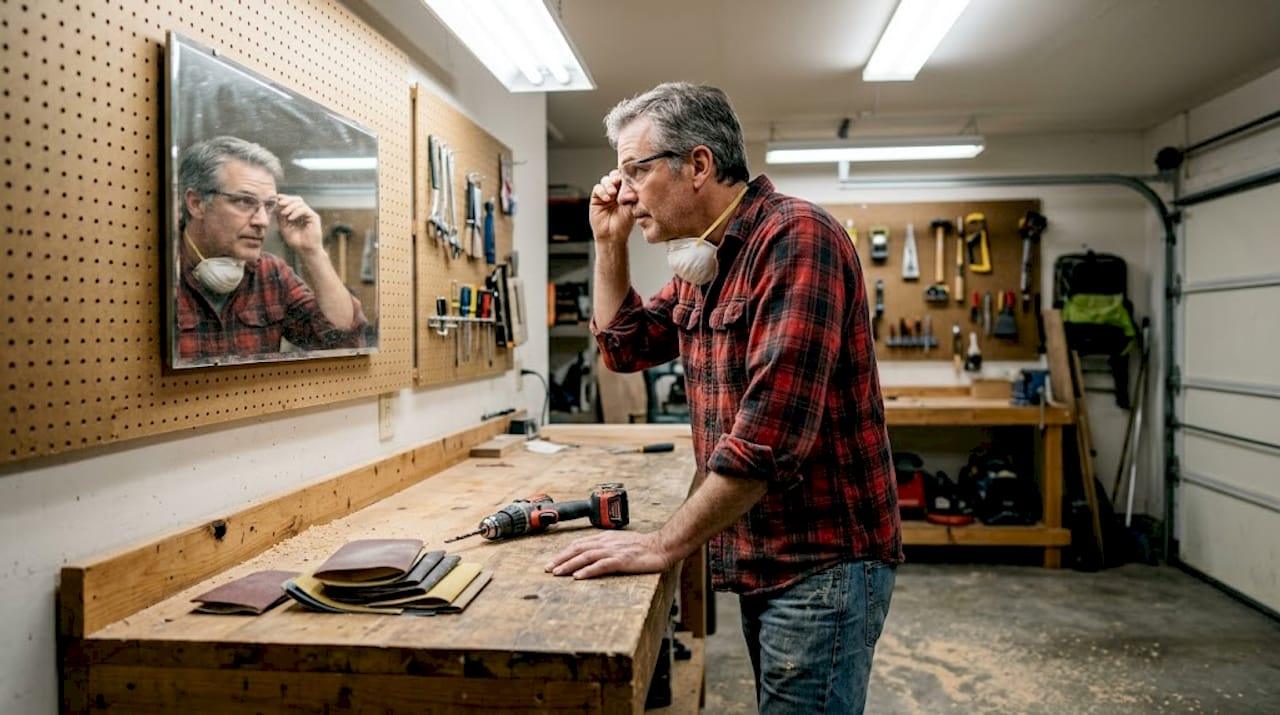
Table saws alone send between 30,000 and 67,000 people to the emergency room every year, cause roughly 4,000 finger amputations, and rack up close to $2 billion in medical costs. Those numbers are not freak accidents. They come from a handful of predictable mistakes made by people who thought they were being careful. Woodworking tool safety is not about fear. It is about understanding exactly what maims woodworkers and building habits that shut those mechanisms down before they start.
Most safety lists tell you to “wear glasses” and “be careful” without ever explaining what actually removes fingers, damages hearing, or throws a board across your garage at highway speed. That advice is useless when you are standing at a live saw with a bad feeling in your gut.
This list gives you 13 rules with the exact specifications that matter: the ANSI stamp your glasses need, the formula for how much noise your earplugs really block, the difference between an N95 and a P100, and the four-part system that stops kickback. Each rule targets a specific injury mechanism, so you remove the causes, not just the symptoms.
1. Wear ANSI Z87.1 Eye Protection Before Every Cut
The safety glasses in your shop drawer may be decorative. Unless they are stamped Z87 somewhere on the frame or lens, they carry no guarantee that they will stop a splinter traveling at speed. Fashion sunglasses and cheap wraparounds shatter into your eye instead of protecting it.
Look for “Z87” molded directly into the frame. That mark means the lens meets the ANSI Z87.1 standard for basic impact protection, which is your minimum. A “Z87+” mark means high-impact rated, and that is what you want for grinding, aggressive routing, and anything that flings hardened chips.
The difference is not marketing. High-impact Z87+ lenses pass a driven-projectile test, where a quarter-inch steel ball is fired at the lens at 150 feet per second. Basic lenses fail that test. When an angle grinder throws a metal fragment, you want the lens that was proven to stop it.
Escalate your protection to match the tool. Wear safety glasses for every cut, no exceptions. Add a full face shield over your glasses for lathe work and aggressive grinding, because a face shield alone does not seal against dust and small particles the way wraparound glasses do.
This is the cheapest rule on the list. Put your glasses on first, before the tool is even plugged in, and you never have to remember mid-task.
2. Calculate Your Real Hearing Protection, Do Not Just Grab Earplugs
Your earplugs block far less noise than the number printed on the box. That number is a lab result under ideal conditions, and your shop is not a lab. Grabbing any foam plug and assuming you are covered is how woodworkers end up with permanent hearing loss they never saw coming.
Damage begins at sustained exposure above 85 decibels. A table saw runs around 100 dB. A router pushes about 105 dB. A circular saw hits roughly 108 dB. Every one sits well above the threshold where your hearing starts to erode.
Use the OSHA derating formula to find your real protection: take the Noise Reduction Rating printed on the package, subtract 7, then divide by 2. That gives you the reduction you can actually expect in the real world.
Run the math on a common plug. An NRR-25 earplug gives you (25 – 7) / 2, which equals 9 dB of real reduction. Put that plug in against a 100 dB table saw and you are still hearing 91 dB, comfortably above the 85 dB damage line.
So set your standard higher. Use an NRR-31 or better plug for the table saw. For the circular saw and router, wear double protection, plugs plus earmuffs over them, which adds roughly 5 dB beyond the higher-rated device alone. Hearing loss is cumulative and permanent, so every session without proper protection adds to a debt you can never repay.
3. Match Your Respirator to the Wood: N95 vs P100
The dust coming off oak and walnut sits in the same cancer category as asbestos. That is not a scare tactic. It is the official classification, and most hobbyists breathe that dust for years without knowing it.
The International Agency for Research on Cancer, in Volume 62 of its monographs published in 1995, classified hardwood dust from species like oak, beech, walnut, and mahogany as a Group 1 carcinogen. That is the highest certainty category, reserved for agents proven to cause cancer in humans. Hardwood dust is specifically linked to nasal adenocarcinoma, a rare cancer of the nasal passages that appears almost exclusively in woodworkers.
Match your respirator to the exposure. An N95 filters 95% of airborne particles and is adequate for occasional DIY work with softwoods like pine. A P100 filters 99.97% and is what you need for sustained hardwood machining, where you are generating fine dust for hours.
Fit matters as much as the rating. A P100 with a gap at your nose bridge is no better than no mask, because unfiltered air takes the path of least resistance straight past the seal. Press the mask to your face and check that it collapses slightly when you inhale.
Match the mask to the wood, not to how dusty the air looks. The most dangerous particles are the fine ones you cannot see hanging in the light.
4. Understand Kickback and Run the 4-Part Prevention System
The table saw’s most dangerous move is not the cut itself. It is the moment the saw grabs your workpiece and hurls it straight back at your body faster than you can flinch.
Here is the mechanism. When the workpiece binds against the blade, the rear teeth, which are spinning upward and toward you, catch the wood and launch it back at 100 to 120 miles per hour. That is faster than human reaction time, so by the time you feel it, the board has already hit you or dragged your hand into the blade.
Kickback is not a rare edge case. Roughly 60% of serious table saw hand injuries are precipitated by a kickback event. The board moves, your hand follows, and the blade is right there.
Woodworking safety instructor Dale Oakfield puts it bluntly: “Kickback deaths are documented. I’ve seen kickback throw boards clear across a two-car garage and embed splinters into drywall.” A board with that much energy does not care where your body is.
Stop it with a four-part system, run every time. First, set the blade no more than a quarter inch above the top face of the workpiece, which limits how much tooth can catch. Second, keep the riving knife installed so the kerf cannot pinch closed behind the blade. Third, stand to the side of the blade, never directly behind it, so a launched board misses you. Fourth, use a push stick whenever your hands come within six inches of the blade.
Memorize these four as a single system, not four separate tips. Kickback exploits the one step you decide to skip.
5. Install a Riving Knife, Not the Old-Style Splitter
The guard most woodworkers rip off and lose in a drawer has a modern replacement designed to stay on the saw. If you are still fighting with an old splitter, you are using outdated equipment that practically invites removal.
A riving knife mounts directly to the arbor assembly, so it moves with the blade as you change height or tilt. It sits just 3 to 8 millimeters behind the blade, curves to match the blade’s radius, and never rises above the top of the blade. Because it stays below the blade top, it works for through cuts, non-through cuts, dados, and rabbets, so you leave it on for nearly everything.
The old splitter is a different animal. It bolts to the trunnion in a fixed position, extends up above the blade, and physically blocks crosscuts and dado cuts. That is exactly why people remove it and then never bother reinstalling it, leaving the saw running naked for the next cut.
Regulation caught up in 2008, when UL 987 began requiring riving knives on all new US table saws, with older designs grandfathered until 2014. Forensic engineering firm Robson Forensic states that a properly installed riving knife “virtually eliminates kickback,” which is about as strong a claim as safety engineers make.
If your saw predates 2010, check the manufacturer for a riving knife retrofit kit. It is one of the highest-return upgrades you can make.
6. Know When to Use a Push Stick vs a Push Block
Reaching for the wrong pusher is worse than reaching for none, because it gives you false confidence while leaving your control weak at the worst moment. These two tools are not interchangeable, and knowing which to grab is part of the skill.
A push stick is narrow, with a notched heel at the bottom that hooks the back edge of the workpiece. It is built for thin rips, where you are feeding stock through the tight gap between the fence and the blade and there is no room for anything wider.
A push block, like the Grr-Ripper style, is broad with a rubber sole that grips the top of the board. It applies downward pressure and control across a wider footprint, which is what you want for pushing narrow stock while keeping it flat and stable on the table.
Both trigger on the same rule: use one whenever your hands would otherwise pass within six inches of the blade. That six-inch buffer is where fingers get taken.
You can make a serviceable push stick from a scrap of plywood in ten minutes, so there is no excuse for not having one. Keep both a stick and a block within arm’s reach of the saw, so choosing the right one never means walking away from a running blade.
7. Position Featherboards Fully in Front of the Blade
A featherboard placed one inch too far back turns a safety device into a kickback machine. Position it wrong and you have built a trap that pins the wood against the blade exactly where you do not want pressure.
A featherboard works through angled flexible fingers that press the workpiece against the fence or table. Those fingers allow the wood to move forward freely but grip and resist any backward movement, which keeps your stock tight to the fence without your hands near the blade.
Here is the critical part. The featherboard must sit fully in front of the blade, never beside it or behind it. If any part of it applies pressure at or behind the blade, it traps the wood against the rear of the blade, which is precisely the pinch that causes kickback. You would be forcing the workpiece into the teeth that throw it back at you.
Verify placement with a simple test before you cut. With the saw off and the featherboard set, the workpiece should slide forward freely and resist firmly when you push it backward. If it grabs going forward or moves easily backward, reset it.
Featherboards free your hands from the danger zone, but only when they are placed correctly. A misplaced one is more dangerous than none.
8. Route in the Right Direction: The L-Finger Rule
Routers have a kickback of their own, and it comes from feeding the workpiece or the router the wrong way. Get the direction backward and the bit stops cutting and starts grabbing.
The wrong direction is called a climb cut. When you feed against the correct direction, the spinning bit grabs the wood and pulls the router along the cut fast, dragging it out of your control. That sudden lunge is the router’s equivalent of table saw kickback, and it happens in a fraction of a second.
The team at 731 Woodworks names it directly: “The mistake number one beginners make is routing in the wrong direction.” It is the single most common way people lose control of a router.
Use the L-finger rule to get it right every time. Make an “L” shape with your left hand, thumb out and index finger extended. The index finger points the direction you should feed, which for outside edges means moving the router counterclockwise around the workpiece, away from you along the front edge.
For inside edges, like the inner perimeter of a frame, you reverse it and feed clockwise. Memorize the hand shape rather than a paragraph of rules, because you need to check direction mid-cut with the router already running.
9. Never Cut a Circular Saw Between Two Fixed Supports
The most natural way to support a board for a circular saw cut is the one that will kick the saw back at you. It looks stable and feels right, which is what makes it so common and so dangerous.
Picture a board resting on two sawhorses, one near each end, and you cutting in the middle. As the blade passes through, both halves begin to sag under their own weight, and the two sides rotate down and inward. That closes the kerf and pinches the blade, which binds instantly and drives the saw back toward you.
Support the cut so the offcut can fall free instead. Position the board so the piece you are cutting off overhangs past a single sawhorse and drops away as the cut completes. Better yet for full sheets, lay the whole panel on a sheet of rigid foam insulation board on the floor and cut right through into the foam, so nothing sags anywhere.
The Funny Carpenter, a woodworker with 30 years on the tools, identifies blade binding as the primary cause of circular saw kickback. Remove the pinch and you remove the kickback.
Think about where the cut piece goes before you pull the trigger, not after. That single second of planning prevents the whole event.
10. Guard the Angle Grinder and Discard Any Dropped Wheel
A cutoff wheel that hit the floor once can end up inside you. These wheels are consumable, cheap, and brittle, and they fail without warning when they are compromised.
Cutoff and grinding wheels are made of bonded abrasive that cracks internally from a single drop or a stepped-on edge. Those cracks are often invisible. Spun up to 9,000 rpm or more, a cracked wheel shatters and throws fragments at speeds that can reach the arteries in your forearm, neck, or thigh.
So the first rule is absolute: discard any wheel that has been dropped or stepped on. No visual inspection can clear it, because the crack you cannot see is the one that kills you. A new wheel costs a few dollars, which is nothing against the alternative.
The second rule is the guard. Keep the wheel guard installed and positioned between the wheel and your body. OSHA requires the guard during both grinding and cutting, and it exists to contain fragments when a wheel does fail.
Watch wire brush wheels too. They are a top entanglement hazard, and they also shed wires that fly off and lodge in skin. The grinder gives no second chances, so toss any suspect wheel without hesitation.
11. No Loose Clothing, No Gloves Near Rotating Blades
The glove you wear to protect your hand is exactly what feeds that hand into the blade. This one feels backward, which is why so many people get it wrong.
The physics are simple and merciless. A rotating blade catches a glove fingertip, a loose cuff, or a hanging drawstring and winds it in instantly. Fabric gives the tool something to grip that your bare skin would not, and once the cloth is caught, your hand follows it straight into the cutter with no chance to pull free.
Gloves have their place. Wear them for handling rough lumber, moving stock, and carrying material, all away from spinning blades. Never wear them near table saws, routers, jointers, or any tool with an exposed rotating cutter.
The same logic covers everything loose on your body. Timber Craft Tutorials documented an incident where an apprentice’s baggy pocket was caught by a belt sander and pulled him into the machine before he could react. Loose fabric near any powered abrasive or blade is an entanglement waiting to happen.
Before you start, roll or button your sleeves, remove hoodie drawstrings, tuck in loose shirts, and tie back long hair. Dress for the machine, not for the weather.
12. Unplug the Tool Before Every Blade Change or Adjustment
“I only left it plugged in for a second” is the opening line of a lot of amputation stories. That second is when the tool starts while your fingers are next to the blade.
Switching a tool off is not the same as disconnecting it. A bumped switch, a faulty trigger, or a helper who does not know your hands are inside the machine can send power to the blade while you are reaching in. The motor does not care that you flipped the switch if electricity can still reach it.
So make the rule physical. Unplug the tool from the wall before every blade or bit change, before you clear a jam, and before you adjust the fence, the blade height, or the tilt. Pull the cord, do not just trust the switch.
The highest-risk moments are the ones that feel safest. Reaching in to pluck a scrap of cutoff from a saw that has stopped spinning but is still plugged in feels routine, and that is exactly when a live tool takes a finger.
Make unplugging a reflex tied to the act of reaching toward the cutter, not a decision you weigh each time. Hand moves toward the blade, cord comes out of the wall, every time.
13. Keep Blades Sharp and the Shop Clear of Dust
A dull blade and a dusty floor are two of the most underrated causes of serious shop injuries, and both are entirely within your control.
Start with the blade. A dull blade burns the wood, binds in the cut, and forces you to push harder to feed stock through. That binding is a direct cause of kickback, and the extra force you apply is what drives your hand forward when the wood suddenly gives or grabs. Keeping your blades sharp is kickback prevention, not just a matter of clean cuts.
Then there is the dust, which carries a hazard most woodworkers never consider: explosion. Fine wood flour has a lower explosive limit of roughly 40 to 60 grams per cubic meter, meaning a cloud that dense can ignite. NFPA 660 flags a shop as at risk when settled dust reaches 3.2 millimeters, about an eighth of an inch, over 5% of upward-facing surfaces or across 93 square meters.
The secondary explosion is the killer. A small primary blast lofts the settled dust off your beams and shelves into a suspended cloud, and that cloud detonates with far more force than the first ignition. Over the past 40 years, combustible dust events have killed 185 workers.
Run dust collection at each tool and sweep the shop at the end of every day. Treat that as safety equipment, not housekeeping.
Ready to put your skills to use safely? Browse free woodworking plans at realwoodworkplans.com.
Once your safety habits are solid, the next step is having good plans to work from. TedsWoodworking has 16,000+ woodworking plans with step-by-step instructions built for the home workshop.
FAQ
What causes table saw kickback?
Kickback occurs when the workpiece binds or pinches against the spinning blade and is thrown back at 100 to 120 miles per hour, faster than reaction time. Common causes include a missing riving knife, a blade set too high, freehanding without a fence, and dull blades that force the cut. About 60% of serious table saw hand injuries follow a kickback event.
Is a riving knife better than a splitter?
Yes. A riving knife moves with the blade, sits 3 to 8 millimeters behind it, and stays on for nearly every cut, including dados and non-through cuts. A splitter is fixed, extends above the blade, and must be removed for crosscuts and dados, which is why people lose them and never reinstall them. UL 987 has required riving knives on new US saws since 2008.
Do I really need hearing protection for woodworking?
Yes. A table saw runs around 100 dB, a router around 105 dB, and a circular saw around 108 dB, all above the 85 dB damage threshold. A common NRR-25 plug only gives about 9 dB of real-world reduction after derating. Use an NRR-31 or better plug for the table saw, and double protection for the circular saw and router.
Is wood dust really dangerous?
Yes. The IARC classifies hardwood dust from oak, beech, walnut, and mahogany as a Group 1 carcinogen, the same category as asbestos, and links it to nasal adenocarcinoma. Use an N95 for occasional softwood work and a P100 for sustained hardwood machining, and add dust collection at the source to cut your exposure.
Push stick or push block: which should I use?
Use a push stick for thin rips in the narrow gap between the fence and the blade, where nothing wider fits. Use a push block, with its broad rubber sole, to apply downward pressure and control on narrow stock. Reach for either one whenever your hand would pass within six inches of the blade, and keep both within arm’s reach.
Can sawdust actually explode?
Yes. Fine wood dust has a lower explosive limit of 40 to 60 grams per cubic meter and can ignite when suspended in air. The bigger danger is a secondary explosion, where a primary blast lofts settled dust into a cloud that then detonates with greater force. Combustible dust events have killed 185 workers over the past 40 years.

“DIY woodworking enthusiast who started with zero experience and a YouTube tutorial.
I build simple, practical projects for my home and share free plans
so other beginners can skip the guesswork.If I can build it, you can too.”