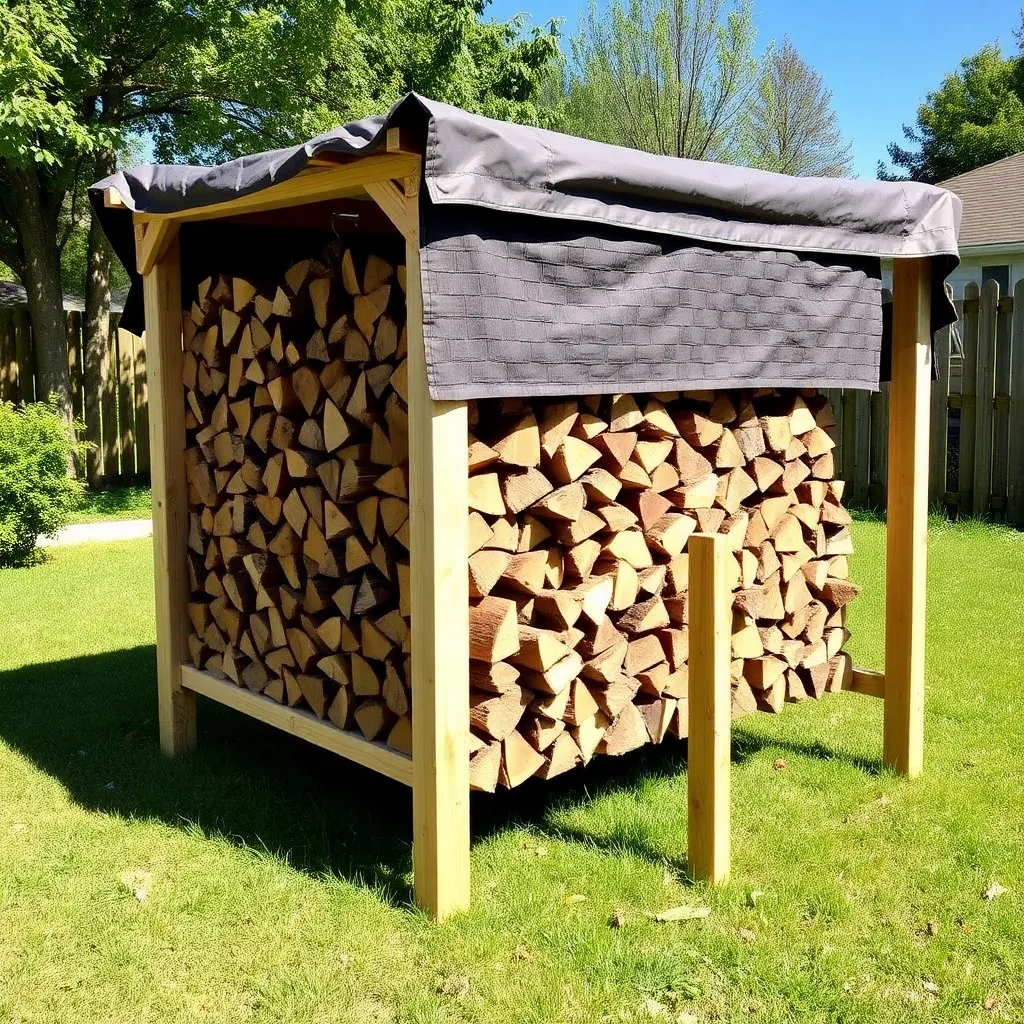
The best firewood storage system is the one that keeps your wood dry, promotes airflow, and fits your available space — not the most expensive or elaborate option. These 12 firewood storage ideas cover every situation from a small apartment deck to a full homestead with 5+ cords of winter wood. Each idea includes approximate cost, storage volume, and the specific conditions it works best for.
Ted’s Woodworking has complete plans for firewood sheds, racks, and storage boxes with cut lists and hardware specs. Browse Ted’s storage plans →
Step 1: Calculate How Much Storage You Need
Ted’s Woodworking has over 16,000 step-by-step plans with cut lists, materials lists, and detailed diagrams. Browse Ted’s plans →
Before choosing a storage method, calculate how much wood you burn per season:
Volume guide:
- Occasional fire (1–2 times per week): 0.25–0.5 cord per season
- Regular fireplace use (every evening in winter): 1–2 cords per season
- Wood stove supplement: 2–3 cords per season
- Primary heat source: 3–6 cords per season (climate dependent)
A cord is 128 cubic feet — a stack 4 feet high × 4 feet deep × 8 feet long. A face cord (also called a rick) is 4×8 feet in face area but only as deep as the log length (usually 16 inches), so approximately 42 cubic feet.
Budget storage for 1.2× your actual consumption — you want to go into winter with 20% surplus so you’re not scrambling if the season runs long.
Step 2: Simple Rack Ideas ($20–$100)
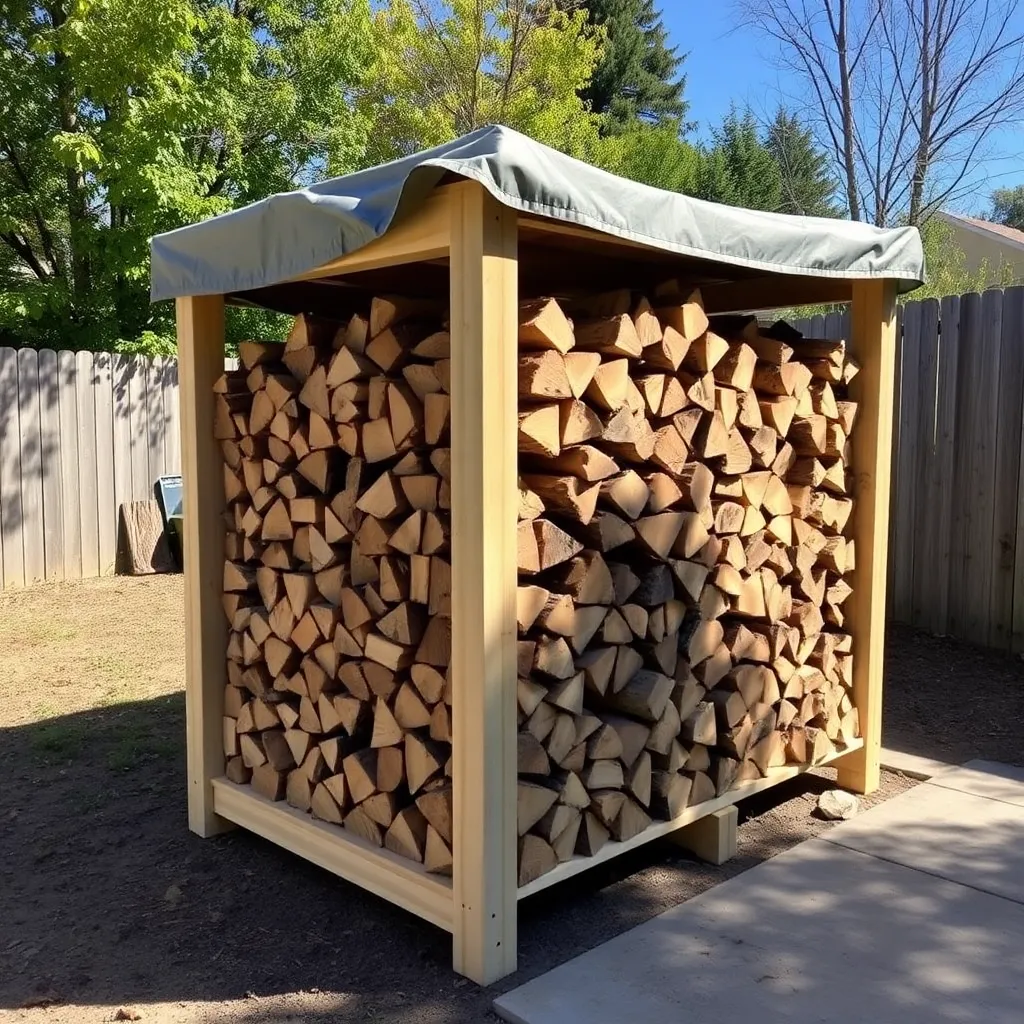
The simplest storage is a freestanding rack that keeps wood off the ground and allows air circulation. Four rack ideas at different price points:
Steel pipe rack ($20–$40):
Two vertical sections of 1-inch galvanized pipe (each 4 feet tall) connected by horizontal crossbars. The end sections are built like a capital H — two vertical pipes connected by a horizontal bar across the top and bottom. Two sections flank each end of the wood stack. Stores 0.25 cord per 4 linear feet of stack length. Add sections as needed.
Lumber rack ($30–$60):
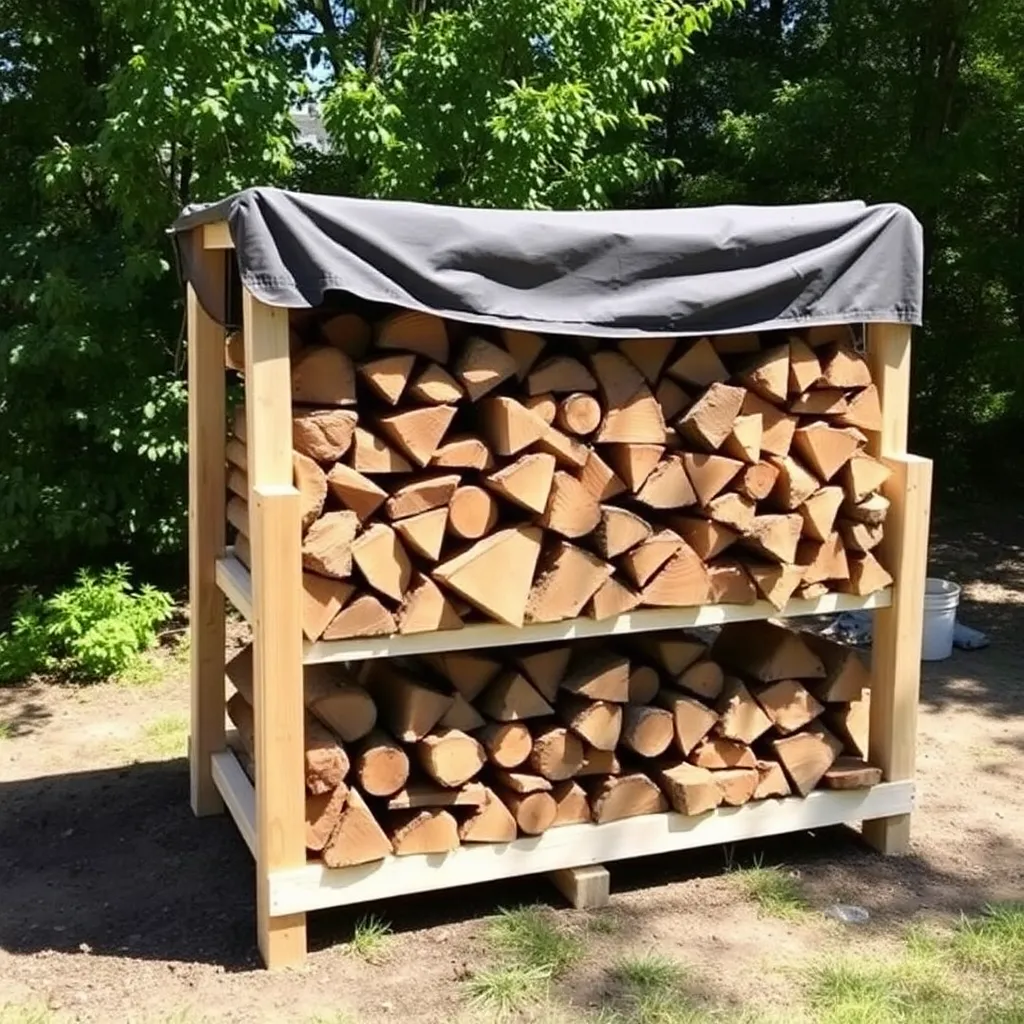
Two A-frame end pieces built from 2×4 lumber, connected by two 2×4 rails running the length of the stack. Wood rests on the rails between the A-frames. Build end frames any height; rails any length. Standard build: 4 feet tall × 8 feet long. Plans: Step 3.
Pallet rack (nearly free):
Two vertical pallets as end pieces, one horizontal pallet as the base. Wire or strap the end pallets upright to stakes or a fence post. Stack wood between them on the base pallet. This is the fastest possible firewood storage and works perfectly well — pallets are often available free at hardware stores, garden centers, and lumber yards.
Covered tarp rack ($40–$80):
Any of the above racks, with a fitted firewood rack cover (a polyester cover that fits over the top of the stack like a hat, with straps underneath). These cost $15–$25 online, cover the top of the stack, and leave the sides open. Better than a blue tarp because the fit is clean and the sides stay open for airflow.
Step 3: Stacking Techniques
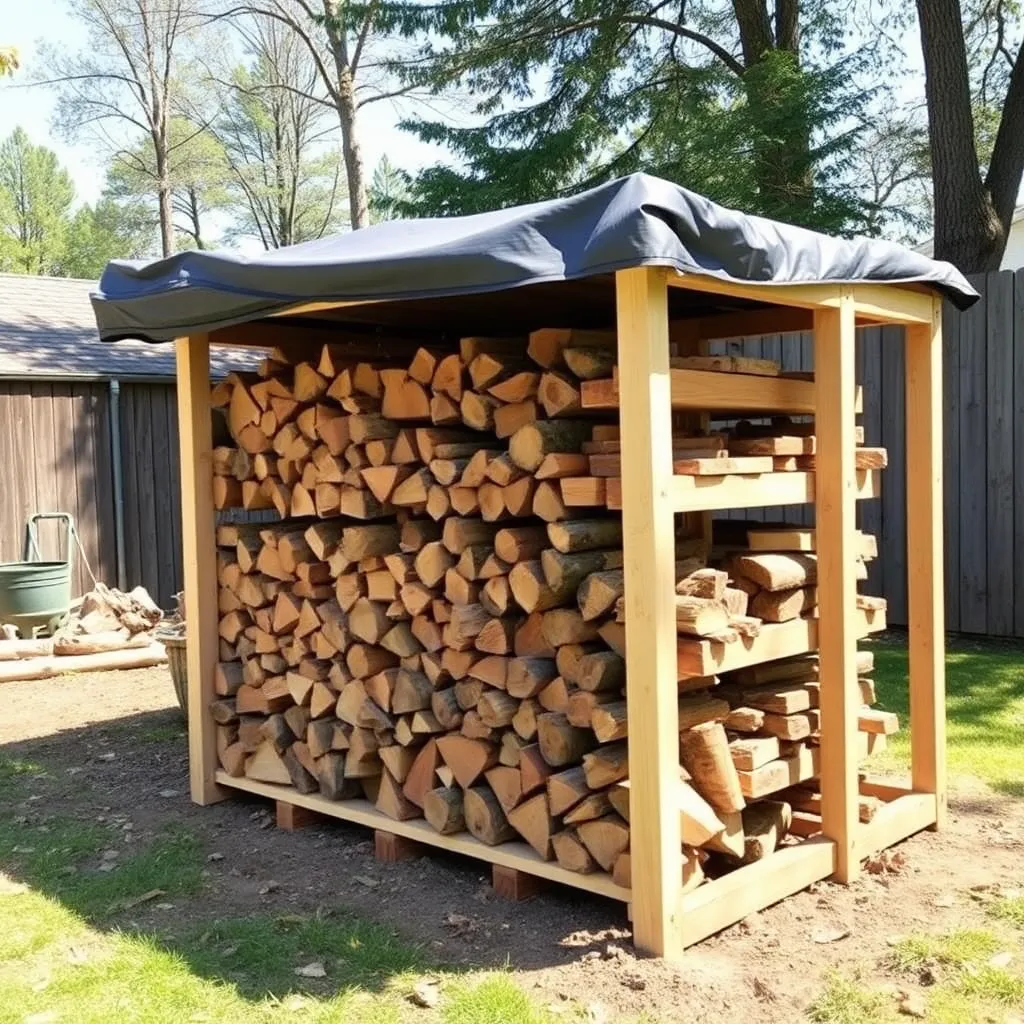
How you stack is as important as what you stack in. Three stacking methods:
The standard row stack:
Logs parallel, bark side up on the top course, stacked in a straight line between two end supports. The most common method and perfectly effective. Alternate the end courses (stack a few logs perpendicular to the main stack at each end) to create interlocking “pillars” that keep the stack from leaning.
The holz hausen (German round stack):
A circular stack with the split faces pointing inward and the bark pointing outward, tapering toward a peak at the top (like a haystack). The center fills with a loose “chimney” of tilted logs that draws air up through the stack. Dries faster than a row stack and looks striking. No end supports needed. Takes practice to build without leaning.
The shaker stack (crisscross ends):
The main body is a standard row, but the ends are built by alternating log directions — one log north-south, next one east-west — creating a self-supporting log-cabin corner. Eliminates the need for end supports and is very stable.
Step 4: Covered Storage Solutions ($100–$350)
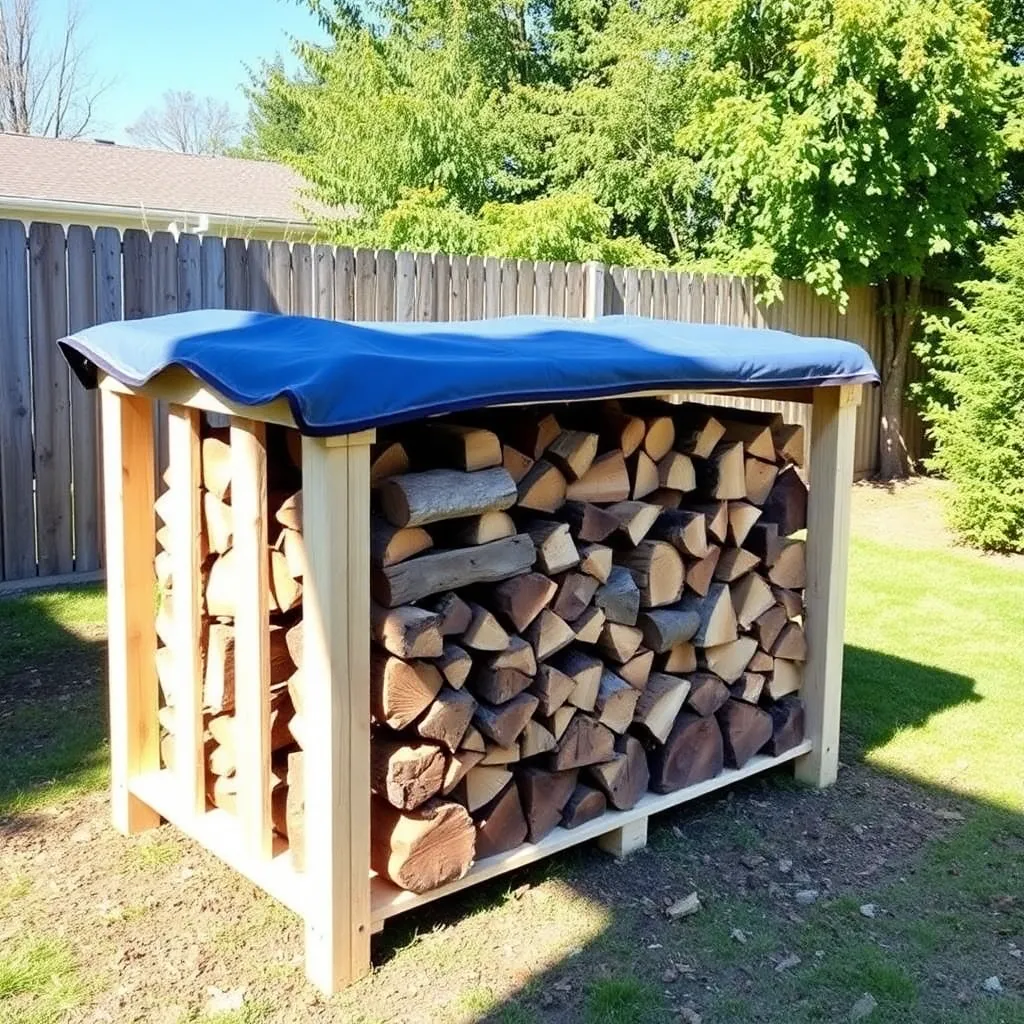
For permanent or semi-permanent storage, a covered structure is worth the investment:
Open-front lean-to shed:
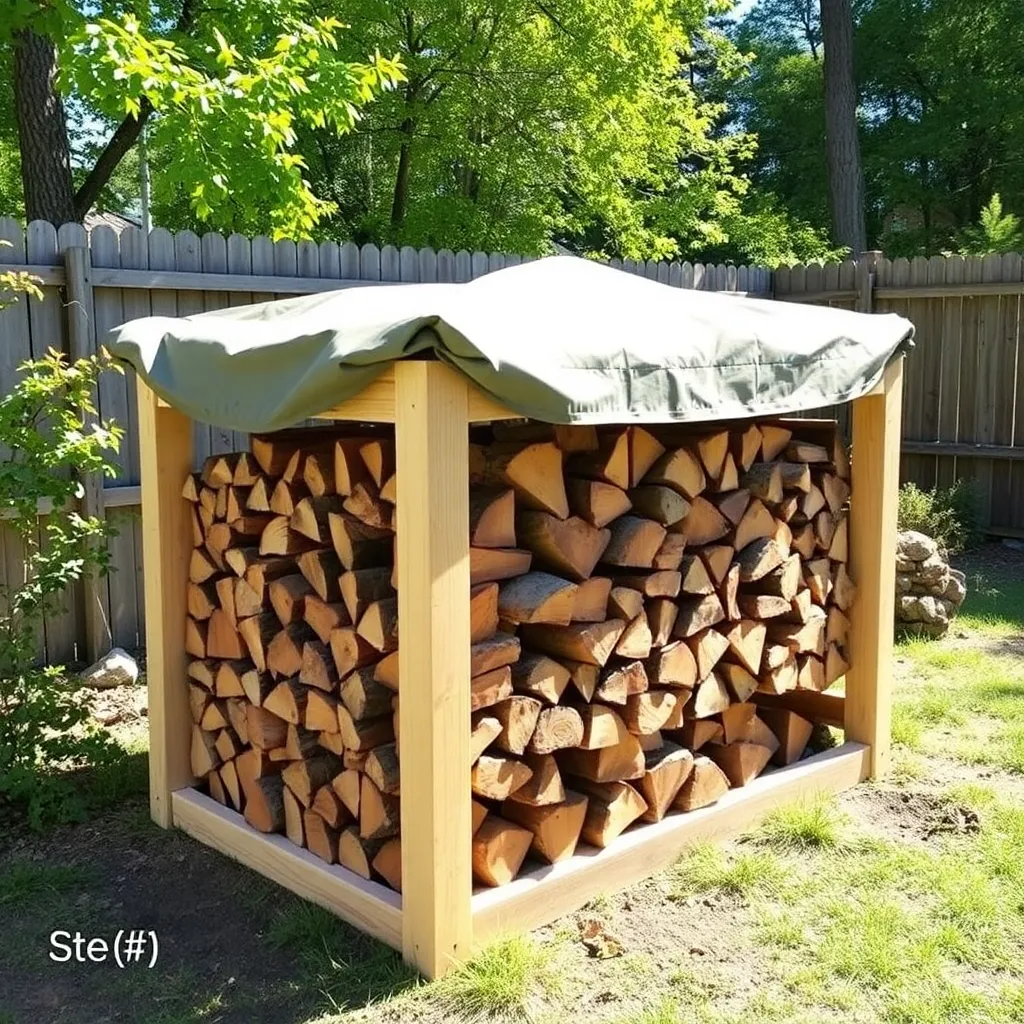
A 3-sided structure (back wall, two side walls, sloped roof) with an open front. This is the classic firewood shed — maximum airflow from the open front, complete rain protection from the roof. Build from 4×4 posts, 2×4 framing, and a metal roof. A 4×8-foot version stores a full cord and costs $200–$300 in materials.
Porch storage rack with roof:
A rack built into the corner of a covered porch — two walls of the porch provide two sides of the storage, and the porch roof provides cover. Add a simple wooden face to contain the stack and you have a built-in wood box that holds a week’s supply steps from the door.
Covered outdoor rack system:
4×4 posts with a metal roof panel running their length — essentially a mini carport for firewood. Build in 4-foot increments. Each 4-foot section holds approximately 0.25 cord. A 16-foot rack (four sections) holds a full cord under cover. Cost: $150–$250 for materials.
Step 5: Indoor Storage Ideas ($50–$300)
Indoor storage keeps wood dry, convenient, and warm (dried wood from a warm indoor space ignites more easily than cold outdoor wood). Three approaches:
Fireside log holder:
A metal or wood-and-metal cradle that sits beside the fireplace, holding 12–24 hours of wood within arm’s reach. Purely functional — size it so you can carry it when full. Weight-rated for 40–60 lbs is sufficient.
Built-in alcove:
A dedicated nook beside the fireplace (if the architecture allows) with a slatted face that shows the stacked logs — a classic feature in craftsman and farmhouse-style homes. Build from 2×4 framing with 1×2 cedar slats on the face. Holds 3–5 days of wood.
Rolling log cart:
A cart on casters with two levels — bottom for split logs, top for kindling. Roll it to the back door for loading, then back beside the fireplace. Useful in homes where the wood pile is far from the door. Build from metal pipe and angle iron, or buy a commercial version ($60–$120).
Step 6: Specialty Storage for Kindling and Fatwood
Kindling needs different storage than split logs — it’s smaller, dries faster, and ideally should be kept inside where it’s driest. Three kindling storage ideas:
Wall-mounted kindling box:
A simple 12×12×18-inch plywood box mounted on the wall beside the fireplace with a hinged lid. Fill it when you bring in the weekly firewood load.
Galvanized metal bin:
A metal garbage can or metal bucket keeps kindling dry, looks clean beside a fireplace, and is fireproof. Drill ventilation holes in the bottom and sides.
Wicker log basket:
The traditional English approach — a large wicker basket beside the hearth holds kindling, a few logs, and fatwood. Natural airflow through the wicker. Not weather-resistant but attractive for indoor use.
Ted’s Woodworking has over 16,000 step-by-step plans with cut lists, materials lists, and detailed diagrams. Browse Ted’s plans →
Firewood Storage Ideas FAQ
What is the best way to store firewood outside?
Elevate the wood off the ground (on a rack, pallets, or pressure-treated sleepers), cover only the top (not the sides), position the stack with the prevailing wind blowing through the exposed sides, and place it in a sunny location if possible. South-facing stacks in the northern hemisphere dry significantly faster than north-facing stacks. Keep 30 feet from the house for large stacks.
How do you store firewood for the winter?
Split wood to 16-inch lengths (standard for most stoves and fireplaces), stack in rows with airflow on both cut ends, cover the top, and let it season. Wood cut and split in spring is ready for the following winter. Wood cut in fall needs at least one full summer to season unless it’s softwood. Store enough for 120% of your expected consumption to have a winter surplus.
What can I use instead of a firewood rack?
Cinder blocks and 2×4 rails work as improvised end supports — set two cinder blocks on each end of the planned stack, lay a 2×4 across each pair, stack wood on the 2×4 rails. Pallets laid flat on the ground elevate wood off the soil. Old metal fence posts driven into the ground at each end of the stack hold it from spreading. Any solution that gets wood off the ground and keeps it contained works.
Can firewood be stored in a garage?
Yes, in small quantities (a week’s supply or less). Large quantities of firewood stored in an attached garage introduce pests (termites, carpenter ants, spiders, mice) and the moisture from unseasoned wood can raise the humidity in the garage. Keep indoor and garage storage to 2–3 days of wood and replenish from the outdoor stack. Never store firewood in a basement — the darkness and humidity keep it wet and attract pests directly into the living space.
How do you season firewood faster?
Split it small (4–6-inch diameter pieces season twice as fast as large rounds), stack it in a sunny exposed location, elevate it off the ground, and cover only the top. A south-facing rack in full sun can season hardwood in 9–12 months instead of 18–24. A solar kiln (a black-painted enclosure with a plastic or polycarbonate roof) can season wood in 4–6 weeks, but it’s a significant construction project.

“DIY woodworking enthusiast who started with zero experience and a YouTube tutorial.
I build simple, practical projects for my home and share free plans
so other beginners can skip the guesswork.If I can build it, you can too.”