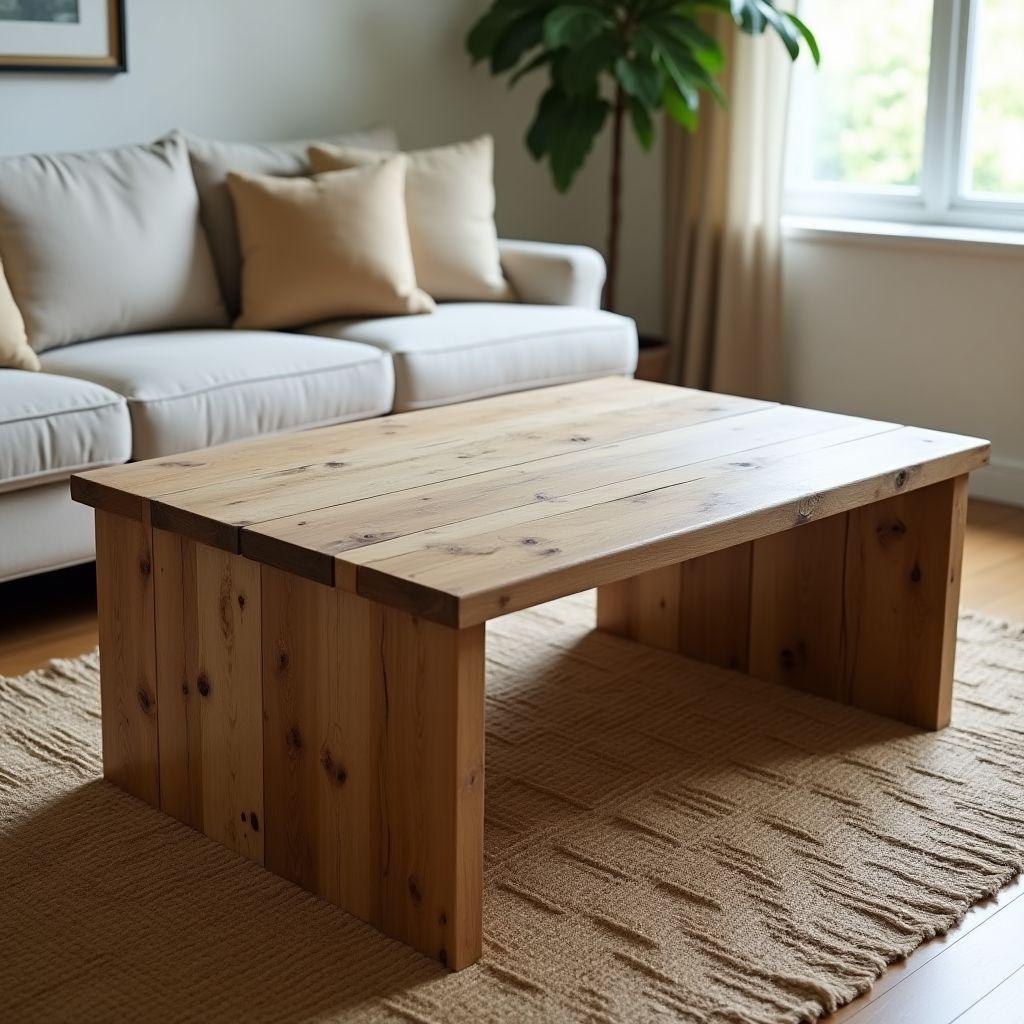
Search “coffee table plans” and you get hundreds of results, dozens of styles, and no clear way to pick one. That flood of options is why so many would-be builders stall out before a single board gets cut. If you also need a dining or patio build, our dining and outdoor table plans cover those separately. This guide stays focused on one thing: helping you choose the right coffee table and start building.
This is a decision guide, not a single tutorial. It breaks coffee tables into 6 distinct types, each with a difficulty rating, a real materials cost range, a build-time estimate, and a clear answer to who the build is for. Whether you are picking up a drill for the first time or looking for a weekend showpiece, one of these six is the right fit.
Here is how to use it. Size your table first, since the wrong dimensions ruin even a flawlessly built piece. Then scan the master comparison table, land on your type, and follow the link to the free plans for that build. You can have a finished table by the end of the weekend.
Size Your Coffee Table First
Looking for more coffee table ideas?
This guide is part of our complete coffee table furniture plans series — compare all options by skill level, cost, and build time.
Want 16,000+ woodworking plans?
Ted’s Woodworking has step-by-step plans for every skill level. Browse Ted’s plans.

Size before style. A perfectly joined tabletop still fails the room if it is too long for the sofa or too tall to reach a mug over.
Start with length. Use the two-thirds rule: your table should run about two-thirds the length of your sofa. A 90″ sofa pairs with a 60″ table; a 72″ sofa pairs with a 48″ table. This keeps the table proportional and within easy reach across the seating.
Next, height. The standard range is 16-18″. Match your sofa’s seat cushion or sit 1-2″ lower. Most sofa seats measure 17-19″, so a table in the 16-18″ band works for nearly every setup. Only high-profile seating, like a tufted traditional sofa, calls for an 18-20″ table.
Then clearance. Leave 12-18″ between the sofa front and the table edge. Twelve inches is the minimum for legroom; 18″ is comfortable. Allow 30″ of walking-path clearance to other furniture so the room still flows.
Width typically lands at 20-28″. Use the sofa-pairing table below as your quick reference before you commit to any style.
| Sofa length | Recommended table length | Table height range |
|---|---|---|
| 60″ | 40″ | 16-17″ |
| 72″ | 48″ | 16-18″ |
| 84″ | 56″ | 17-18″ |
| 90″ | 60″ | 17-19″ |
Quick Comparison: All 6 Types at a Glance
This master table compares all 6 coffee table types on the four things that decide a build: difficulty, time, cost, and best use. If you are new, sort by difficulty and start with a Beginner build. If money is tight, read the cost column first. If you already know your need, jump to the “Best For” column.
Each type gets its own section below with full details, failure points to avoid, and a link to the free plans.
| Type | Difficulty | Build Time | Cost Range | Best For |
|---|---|---|---|---|
| Farmhouse / Rustic Plank | Beginner | 6-8 hrs | $40-200 | Budget farmhouse & country rooms |
| Basic DIY 2×4 | Beginner | 2-4 hrs | $20-50 | True first-timers & renters |
| Lift-Top with Storage | Intermediate | 10-16 hrs | $100-400 | Small apartments & WFH users |
| Nesting Tables | Beginner-Intermediate | 8-18 hrs | $60-300 | Small spaces & multipurpose use |
| Puzzle / Interlocking | Intermediate | 12-20 hrs | $100-400 | Showpiece & game-night builders |
| Mid-Century Hairpin Leg | Beginner-Intermediate | 4-8 hrs | $80-450 | Fast build, high visual payoff |
Type 1: Farmhouse and Rustic Plank Coffee Table Plans

| Attribute | Value |
|---|---|
| Difficulty | Beginner |
| Build Time | 6-8 hrs (14 with finish) |
| Cost | $40-200 |
| Dimensions | 48″L x 24″W x 18″H |
| Key skill | Pocket hole joinery |
This is the build realwoodworkplans.com recommends for most first-timers. It suits farmhouse, country, cottage, and boho rooms, and it forgives a beginner’s mistakes.
The typical table runs 48″L x 24″W x 18″H, with room to scale anywhere from 40-54″ long and 22-30″ wide. The joinery is pocket holes only. There are no mortise-and-tenon joints to cut, so a drill, a saw, and a Kreg jig are all you need.
Wood options keep it affordable. Pine and fir are the cheapest and most beginner-friendly. Poplar steps up in hardness and takes paint cleanly. Reclaimed barn wood delivers the most character at the top of the budget.
Cost breaks into three tiers. Budget pine builds run $40-75. A mid-grade table in select pine or poplar with a poly finish lands at $75-130. Reclaimed or surfaced-pine premium builds reach $130-200.
The one failure point is skipping wood prep. Cupped or unflattened boards leave gaps and a tabletop that rocks. Flatten and check every board before assembly. Style it with shiplap walls, a linen sofa, and neutral tones.
For the full cut list and free plans, see our farmhouse coffee table plans.
Type 2: Basic DIY 2×4 Coffee Table Plans
| Attribute | Value |
|---|---|
| Difficulty | Beginner |
| Build Time | 2-4 hrs (6-8 with finish) |
| Cost | $20-50 |
| Dimensions | 40-48″L x 20-24″W x 16-18″H |
| Key skill | Gluing a flat 2×4 top |
This is the cheapest and fastest build in the group. Materials run $20-50, and the table comes together in 2-4 hours, plus another 6-8 with stain and finish coats. Some builders finish the whole thing in under two hours.
It is built for true beginners, renters, and anyone tackling their first-ever woodworking project. It also holds up in a garage or on a patio where you do not want to risk expensive lumber.
Dimensions land at 40-48″L x 20-24″W x 16-18″H. The material list is simple: 6-8 pieces of 2x4x8, a box of pocket screws, and a basic stain. A 2x4x8 stud runs $5-8 in 2026.
The key skill is gluing up a flat top from multiple 2x4s and squaring the base. Neither is hard, but both reward patience.
The one failure point is lumber that is not kiln-dried. Green studs warp and twist after assembly and pull your flat top out of shape. Buy kiln-dried boards every time. This style pairs with industrial, farmhouse-casual, workshop-chic, and outdoor rooms.
For the full free plans, see our DIY coffee table plans.
Type 3: Lift-Top Coffee Table Plans with Storage

| Attribute | Value |
|---|---|
| Difficulty | Intermediate |
| Build Time | 10-16 hrs |
| Cost | $100-400 |
| Dimensions | 48″L x 24″W x 18″H (opens to 28-30″) |
| Key skill | Box construction + mechanism alignment |
This is the most functional type. The top hides interior storage and lifts to a 28-30″ working height, turning the table into a laptop desk or a spot to eat dinner from the sofa.
It fits small apartments, work-from-home users, TV-tray replacements, and hidden toy storage. Closed, it measures 48″L x 24″W x 18″H.
The mechanism is the heart of the build, and you have three options. Spring-assist hinges cost $20-40 and hold up to 100 lbs. Gas-lift mechanisms run $40-65, handle up to 150 lbs, and give the smoothest motion. Scissor lifts cost $35-55, carry 100-200 lbs, and are the most complex to align.
Cost runs $100-400, from a pine-plywood budget build to a hardwood face-frame premium version with soft-close hardware.
This is an intermediate build because it combines box construction with mechanism alignment. The hinge pivot point must sit level, or the top binds and refuses to close flush. The common failure point is miscalculating lift clearance and top-rail interference, so dry-fit the mechanism before final assembly.
For the full free plans, see our lift-top coffee table plans with storage.
Type 4: Nesting Coffee Table Plans

| Attribute | Value |
|---|---|
| Difficulty | Beginner-Intermediate |
| Build Time | 8-18 hrs |
| Cost | $60-300 |
| Dimensions | 42″/36″/30″ stepped set |
| Key skill | Consistent sizing math (no binding) |
This is the space-saver almost no one publishes free plans for. A set of two or three tables slides together into one footprint, then separates so everyone at a gathering has a surface.
It is built for small spaces, rentals, and apartments under 700 sq ft, where each table can double as a side table. A typical stepped set runs 42″, 36″, and 30″ long, with the depth held constant across all three so they nest cleanly.
The sizing formula is what makes it work. Each nested table is narrower by two times the leg thickness plus 1/2″ of clearance, and shorter by one leg thickness. With 1.5″ legs, each table drops 3.5″ in width and 1.5″ in length from the one above it.
Cost runs $60-300. A two-table pine set lands at $60-100; a three-table walnut or oak set reaches $175-300.
The skill here is consistency, not complex joinery. Cut every matching part to the same measurement so the tables slide without binding. Pocket holes handle all the assembly. Style them with Scandinavian, minimal, or transitional rooms.
For the full free plans, see our nesting coffee table plans.
Type 5: Puzzle and Interlocking Coffee Table Plans

| Attribute | Value |
|---|---|
| Difficulty | Intermediate |
| Build Time | 12-20 hrs |
| Cost | $100-400 |
| Dimensions | 48″L x 26″W x 20″H |
| Key skill | Router precision cuts, cross-halving joints |
This is the showpiece. The base holds together with cross-halving and castle joints instead of fasteners, so the joinery itself becomes the design.
There are two variants. The first is a purely interlocking geometric base that stands on precision joints alone. The second is a flip-top version that hides a puzzle or game work surface, opening to roughly 21.5″ x 32″. realwoodworkplans.com recommends the flip-top storage variant as the more practical pick for most DIYers.
The full table measures 48″L x 26″W x 20″H. This build needs a router or jigsaw for the precision cuts: dado channels, curved edges, and clean interlocking joints. A table saw handles the castle joints.
Cost runs $100-400, from a pine-plywood budget build to hardwood plywood with quality drawer hardware.
It suits puzzle hobbyists, game nights, and families. It is not a first-time build. The joinery leaves little margin for error, so come to it with a project or two already behind you.
For the full free plans, see our puzzle coffee table plans.
Type 6: Mid-Century Modern and Hairpin Leg Coffee Table Plans

| Attribute | Value |
|---|---|
| Difficulty | Beginner-Intermediate |
| Build Time | 4-8 hrs |
| Cost | $80-450 |
| Dimensions | 48-50″L x 22-28″W x 16-18″H |
| Key skill | Flat top prep + cleats for plywood |
This is the fastest build with the highest visual payoff. Top prep, leg attachment, and finish take just 4-8 hours, and the result looks like a store-bought designer piece.
It suits mid-century, Scandinavian, retro, and minimalist rooms. It is lightweight and apartment-friendly. Dimensions run 48-50″L x 22-28″W x 16-18″H; 16″ legs plus a roughly 1″ top give a finished height near 17″.
Hairpin legs do the heavy lifting on style. A set of 4 costs $25-110, from budget generics to premium steel. Most sets ship with pre-drilled mounting plates and 3/4″ screws, so predrill your pilot holes to keep the wood from splitting.
The top makes or breaks the look. Walnut reads premium and pairs well with a Danish oil finish. Plywood tops need cleat backing on the underside to prevent sag over time. Run any top at a minimum of 3/4″ thick, with 1.5″ ideal for a solid walnut build.
Cost runs $80-450, from a budget pine or plywood top to solid walnut on premium legs.
This type does not have its own plan page yet. For dimensioned plans and a complete cut list, browse this full woodworking plan library.
Which Coffee Table Plan Should You Build?
Match your situation to the right type and skip the second-guessing.
If your budget is under $75, build the farmhouse plank or the basic 2×4. Both use construction lumber and pocket holes, so material cost stays low. If you need hidden storage, the lift-top is the only type that delivers it.
If you are working with a small space, nesting tables collapse into one footprint. If you want a conversation-piece showpiece, the puzzle or interlocking table earns the extra hours. If speed matters most, the mid-century hairpin-leg table finishes fastest. And if this is your very first build, start with the basic 2×4.
| If you want… | Build this |
|---|---|
| Lowest cost (under $75) | Farmhouse or Basic 2×4 |
| Hidden storage | Lift-Top |
| To save space | Nesting Tables |
| A conversation-piece showpiece | Puzzle / Interlocking |
| The fastest build | Mid-Century Hairpin Leg |
| Your very first build | Basic 2×4 |
To browse every style in one place, see our full coffee table furniture plans library.
Frequently Asked Questions
What size coffee table fits a 3-seat sofa?
A 3-seat sofa runs 84-90″ long. Apply the two-thirds rule and your table should be 56-60″ long. Keep the width at 20-28″ and the height at 16-18″, within 1-2″ of your sofa’s seat height. Leave 12-18″ of clearance between the sofa front and the table edge so there is room for legs.
What height should a coffee table be?
The standard range is 16-18″. The ideal height matches your sofa’s seat cushion or sits 1-2″ lower. Most sofa seats measure 17-20″, so a table in the 16-18″ band works for nearly every setup. Reserve taller 18-20″ tables for high-profile seating like tufted traditional sofas.
How much does it cost to build a coffee table?
Costs depend on type. A basic 2×4 table runs $20-50 in lumber. A farmhouse pine table costs $60-130. A lift-top with storage runs $150-300 including hardware. A mid-century walnut hairpin-leg table costs $200-450 depending on wood grade. Budget versions of all six styles land under $130.
What wood is best for a coffee table?
Pine is the cheapest and most beginner-friendly. Poplar is harder and takes paint well. Red and white oak add durability at $6-10 per board foot. Black walnut is the premium choice for modern styles at $10-16 per board foot. Birch plywood is best for lift-top and puzzle boxes where you need flat, stable panels.
How long does it take to build a coffee table?
It depends on type. A basic 2×4 table takes 2-4 hours. A farmhouse plank table takes 6-8 hours. A lift-top with storage needs 10-16 hours across one or two weekends. A nesting set of three takes 12-18 hours. Add 1-2 days for stain and finish coats to dry, whichever type you build.
What is the easiest coffee table to build?
The basic 2×4 slab table is the easiest: a flat glued-up top on simple legs, built with a drill and circular saw using pocket holes only. Some builders finish it in under two hours. The farmhouse plank table is a close second, also pocket-hole-only, and just as forgiving for a first project.
Do I need a planer to build a coffee table?
No. Most plans use dimensional lumber like 2×4, 1×6, and 1×10, or plywood, all already surfaced at the mill. A planer is only needed for rough-sawn stock such as raw walnut slabs. For 90% of builds, a miter saw, circular saw, drill, and pocket hole jig cover everything you need.
What finish is best for a coffee table top?
Oil-based polyurethane in 2-3 coats is the most durable against scratches, spills, and heat. Water-based poly is a faster-drying, non-yellowing alternative for light wood. Danish or hardwax oil gives a natural hand-rubbed look but needs annual maintenance. Avoid wax-only finishes on high-use tables, since they wear through fast.
Related Articles

“DIY woodworking enthusiast who started with zero experience and a YouTube tutorial.
I build simple, practical projects for my home and share free plans
so other beginners can skip the guesswork.If I can build it, you can too.”